
Introduction
Every industrial filtration system starts with a panel. It is the first filter the air meets, the cheapest filter in the train, and the one whose failure costs the most — because a panel that does not do its job passes its load to every filter behind it. This guide covers industrial panel filters: the types, the grades, where they fit in the intake train, and how to select the right one for the site instead of the one that happens to be in stock.
What an industrial panel filter is
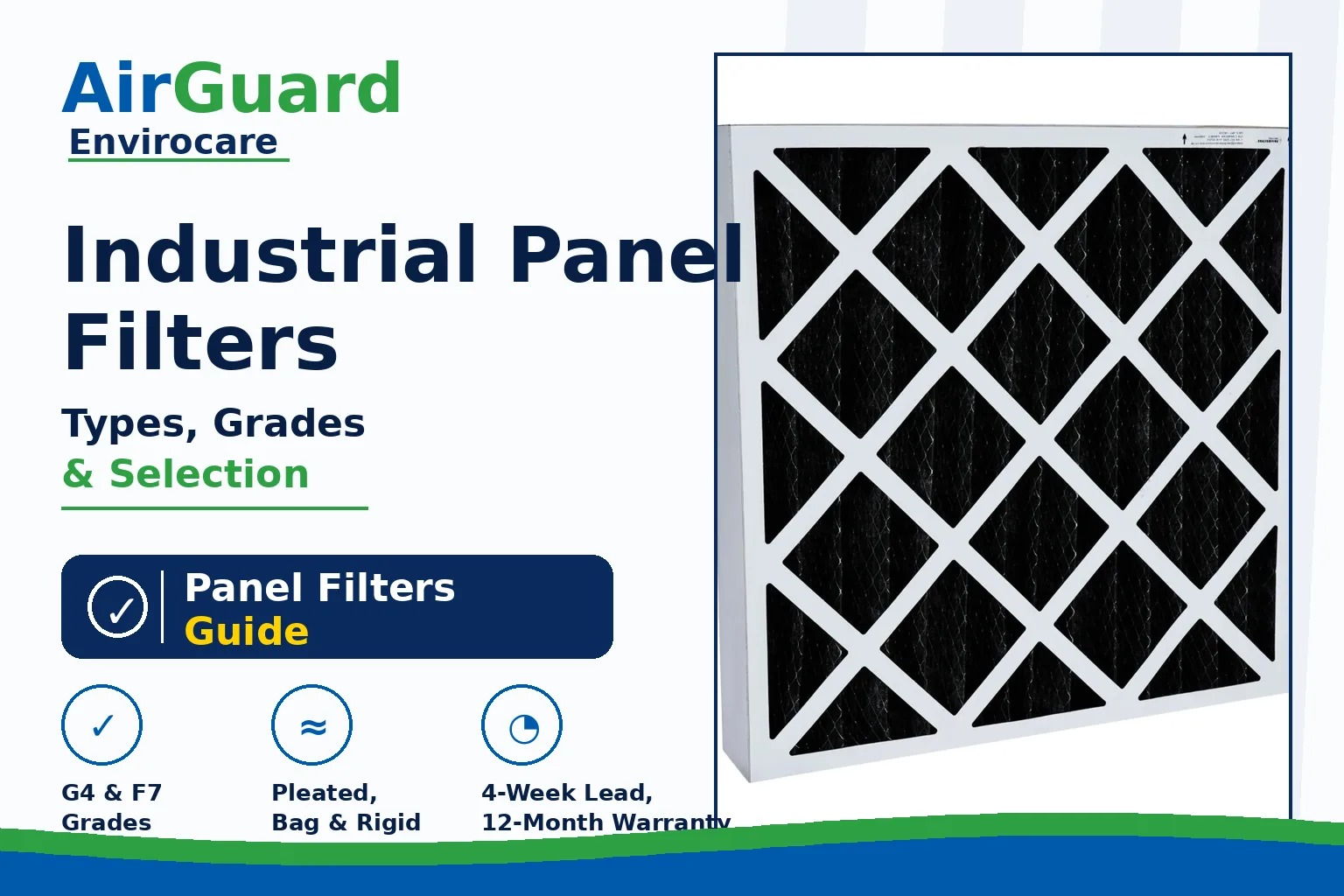
An industrial panel filter is a flat, framed filter, usually pleated, that sits at the front of an air handling or intake system and removes coarse dust and large particles. The pleating is the point: folding the media into pleats packs far more surface area into the same face size, which means more dust-holding capacity and a lower pressure drop than a flat sheet of the same media. The frame — typically a moisture-resistant board or metal — holds the media rigid, seals against the housing, and lets the filter be changed quickly.
Panel filters are used in two very different places, and the selection logic differs for each. In HVAC and general industrial air handling, the panel is often the only filter, or the first of two stages. In a gas turbine intake, the panel is the first stage of a train — pre-filter, coalescer, high-efficiency final — and its job is to protect the expensive filters behind it. The same product can serve both duties, but the specification should always start with the duty, not the product.
Grades: G4, F7 and what the letters mean
Panel filters are graded by efficiency class, and the class is defined by a test standard, not by the manufacturer. The two grades that matter most in Airguard's range are G4 and F7, both under EN 779 (with ISO 16890 as the newer global standard — the air filters classification guide explains the rating systems in full).
G4 is a coarse grade. It captures large dust and fibres, keeps resistance low, and is the standard choice for a first-stage pre-filter. Airguard's G4 panel filter and the DPGT-AG — a GE-equivalent industrial panel filter for the LM6000 gas turbine — are both built to this grade.
F7 is a fine grade. It captures much smaller particles than G4, at the cost of higher resistance and a shorter life at the same dust loading. The F7 panel filter is used where the panel must do more than pre-filter — for example as the final stage in an HVAC system, or as a higher-grade first stage where the downstream filters need extra protection.
The rule is simple: use the coarsest grade that does the job. A finer grade than the duty needs raises pressure drop, shortens change-out intervals and costs more — without protecting anything extra. A coarser grade than the duty needs passes dust downstream, where the next stage pays for it. Match the grade to the duty, and confirm it against the original specification, not against whatever was ordered last time.
Pleated, bag and rigid: the panel family
"Panel filter" covers a family of constructions, and the construction should match the application:
Construction | Best for | Watch out for |
|---|---|---|
Pleated panel | General pre-filtration, high dust capacity | Frame seal — a warped frame bypasses the media |
Glass panel | Coarse pre-filtration, low cost | Handle with care; media is fragile when wet |
Carbon panel | Odour and gas removal alongside dust | Carbon life is separate from dust life |
Rigid bag / V-cell | High airflow, long service intervals | Higher cost; confirm the housing depth |
Airguard's range includes pleated panels (G4, F7, DPGT-AG), glass panel filters and carbon panel filters, plus rigid bag and V-cell filters for high-airflow duties. The category page lists the full range. The selection question is always the same: what is the filter protecting, what is the airflow, and what is the change-out interval the site can live with.
Where panels fit in the intake train
In a gas turbine intake, the panel is the sacrificial stage. The train is pre-filter, coalescer, high-efficiency final, and the panel's job is to take the bulk loading so the coalescer and the final filter last a full interval. A panel that is skipped, or left in place too long, passes its load downstream: the coalescer wets and loads early, the final filter loads in months instead of a year, and the turbine's pressure drop rises faster than the schedule expects. The gas turbine intake filters guide sets out the whole train; the panel is where it starts.
In HVAC and industrial air handling, the panel is often the whole system — or the first of two stages with a bag filter behind it. Here the panel's grade decides the air quality the building gets, and the change-out interval decides the energy bill: a loaded panel raises fan energy, so a panel changed late costs electricity every hour it stays in.
How to select the right panel filter
Selection is a short checklist, and every item on it is verifiable before ordering:
Duty: pre-filter for a turbine intake, final filter for HVAC, or first stage of a two-stage system. The duty sets the grade.
Grade: G4 for coarse pre-filtration, F7 where finer capture is needed. Confirm the grade against the original specification, with the test standard behind it.
Dimensions: face size, depth and frame type. A panel a few millimetres out will not seal, and an unsealed panel is a bypass path, whatever its grade.
Airflow: the site's design airflow against the filter's rated range. A panel undersized for the airflow runs at a high face velocity, loads fast and raises pressure drop.
Media and construction: synthetic pleated media for most duties; moisture-resistant frames where humidity or wetting is a factor; carbon media only where odour or gas removal is actually required.
Environment: dust loading, humidity, temperature and any chemical exposure. A coastal site needs a frame and media that tolerate salt air; a hot site needs a media rated for the temperature.
Change-out interval: how often the site can change the panel, and what the resistance limit is. The interval should be set from pressure-drop readings, not from the calendar alone.
For OEM replacements, the same discipline applies as for any equivalent: match on part number, dimensions, grade and media, in writing. The DPGT-AG is the worked example in this range — a GE-equivalent industrial panel filter for the LM6000, cross-referenced to GE PN 207D1202P0001 and GE LM6000 PN 0423495 — and the GE gas turbine inlet filters guide works through its specification in full. Parker / Altair equivalent Filters follow the same rule: the part number is the starting point, and the specification is the proof.
Change-out timing and practice
Panel filters are changed on pressure drop, with calendar intervals as a backstop. As a starting point, pre-filter panels last 3 to 6 months, but the site's own conditions decide the real interval — a dusty site shortens it, a clean site stretches it. Run one full cycle, log the readings, and set the interval from the data. The air filter replacement guide covers the timing logic in detail.
Change the panel at a planned stop, with the system isolated. Inspect the housing while it is empty: clean the tracks, check the gaskets and seals, and look for corrosion or damage that would let air bypass the new filter. Fit the panel the right way round — airflow direction matters, and a panel fitted backwards loads unevenly and seals badly. Check the seal all round the frame, record the date and the pressure-drop reading, and order the next set a full lead time ahead. Four weeks is the standard lead time for made-to-order industrial filters, so a change-out delayed because the filters are on order is a change-out that should have been planned.
Common mistakes
Fitting a finer grade than the duty needs. It raises pressure drop and shortens intervals without protecting anything extra.
Fitting a coarser grade than the duty needs. It passes dust downstream, where the next stage pays for it.
Matching size without matching grade. Two panels can look identical and perform very differently depending on the media and rated class.
Ignoring the frame seal. A warped frame or a perished gasket bypasses the finest media ever made.
Changing on the calendar instead of on pressure drop. A dusty site and a clean site load the same panel at very different rates; the reading is the decision, the calendar is the backstop.
Reordering whatever was ordered last time. Specifications drift, systems change, and the original grade should be reconfirmed at every reorder.
Wrapping up
An industrial panel filter is the cheapest filter in the system and the one whose failure costs the most. Select it on duty, grade, dimensions, airflow, media and environment; verify the grade against the original specification; change it on pressure drop; and keep the match on file for the next order. Done that way, the panel does its job quietly — the coarse dust never reaches the stages behind it, the pressure drop stays where it should, and the expensive filters last the interval they were designed for. To start a match, send the existing part number and the specification — and request a free estimate for the panels the site needs.
FAQs
What is an industrial panel filter?
A flat, framed, usually pleated filter that sits at the front of an air handling or intake system and removes coarse dust and large particles. It is the first stage in most industrial filtration trains, protecting the finer filters behind it.
What is the difference between G4 and F7 panel filters?
G4 is a coarse grade under EN 779, used for first-stage pre-filtration with low resistance. F7 is a fine grade that captures much smaller particles, at higher resistance and a shorter life at the same dust loading. The right grade depends on the duty, not on the price.
How often should industrial panel filters be changed?
Change on pressure drop, not on the calendar alone. As a starting point, pre-filter panels last 3 to 6 months, but dusty sites shorten the interval and clean sites stretch it. Log the readings and set the site's interval from the data.
Can panel filters be used in gas turbine intakes?
Yes — as the first, pre-filter stage of the intake train, ahead of the coalescer and the high-efficiency final filter. The DPGT-AG is an example: a G4-rated industrial panel filter supplied as a GE-equivalent for the LM6000 gas turbine.
How do I match a panel filter to the original?
Send the original part number, the face dimensions and depth, the grade, the design airflow and the operating environment. The supplier cross-checks the part number and confirms the match — dimensions, grade and media — in writing before quoting.