
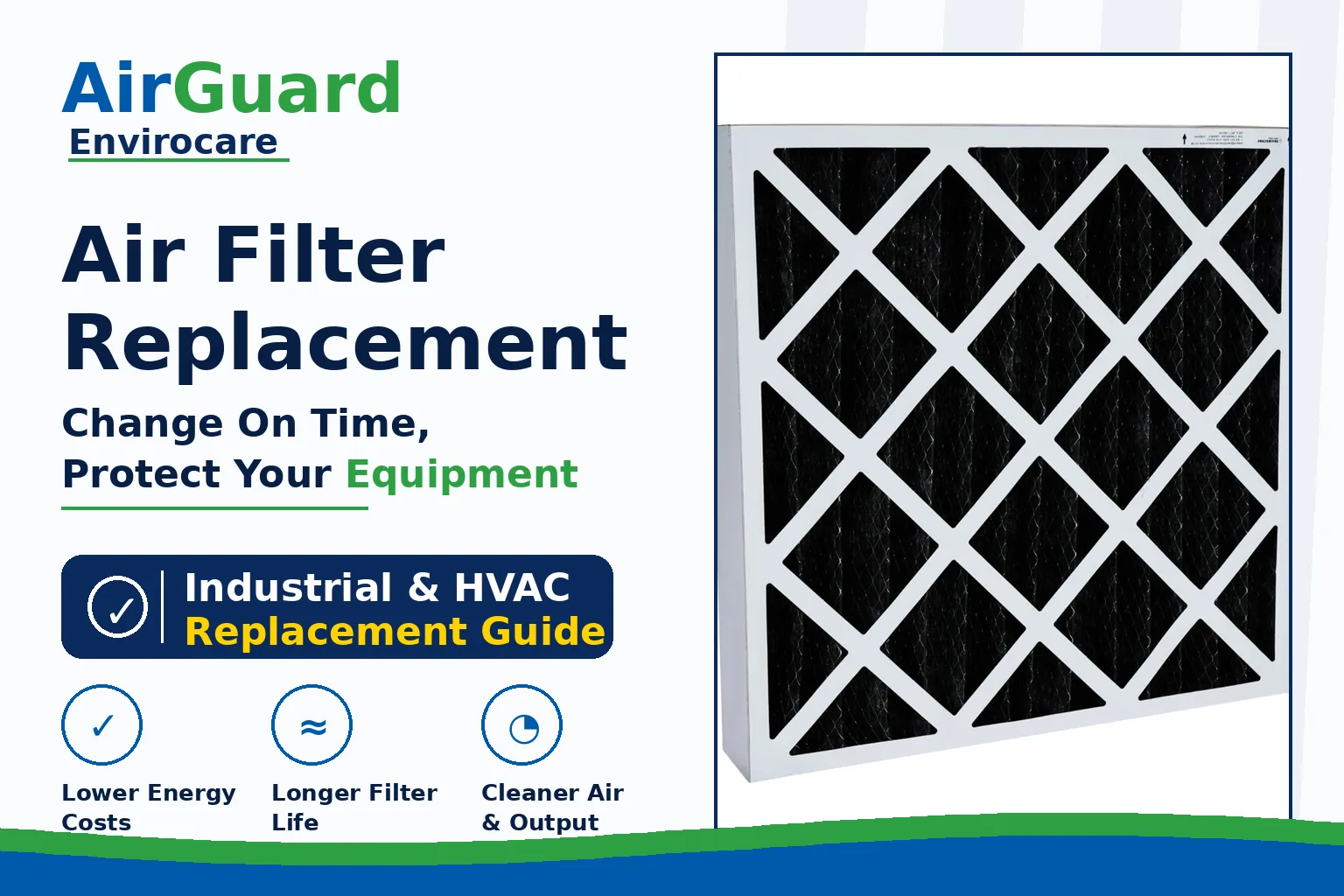
Introduction
Every filter has a working life, and air filter replacement is the single most cost-effective maintenance task in industrial air filtration. A filter changed on time protects the equipment behind it, keeps energy use down and holds air quality where it should be. A filter changed too late does the opposite: pressure drop climbs, fans work harder, dust and moisture break through, and the equipment the filter was supposed to protect starts to suffer. This guide explains how often industrial and HVAC filters should be replaced, what signs mean the time has come, and how to set a changeout schedule that fits the site instead of the calendar alone.
Why replacement timing matters more than most people think
A new filter is at its most open. Air passes through easily, pressure drop is low and capture efficiency is at its rated level. As the filter loads with dust, its resistance rises. At first the rise is slow and harmless. Then it steepens. Fan energy follows the same curve: the harder the fan must push, the more power it draws. In a large plant the extra energy across a year of late changeouts can cost far more than the filters themselves.
There is a second cost that is harder to see. A loaded filter that is left in place eventually lets contaminants through, either because the media is damaged, because air finds a bypass path around a distorted frame, or because the filter is simply overwhelmed. In a gas turbine intake that means fouling and corrosion downstream. In an HVAC system it means dirty coils, poor indoor air and complaints. In a spray booth it means defects in the finish. None of these failures announce themselves as a filter problem. They show up as a turbine wash, a coil clean or a repaint — all far more expensive than a filter.
The right replacement point is therefore not "when the filter looks dirty" and not "when the calendar says so". It is when the filter's resistance, condition or age reaches the limit the system was designed around. Everything in this guide works toward finding that point.
The signs that a filter needs replacing
The most reliable sign is pressure drop. Most industrial systems are designed with a final pressure drop — the resistance at which the filter should be changed. It is usually measured in pascals across the filter, and the value is set by the system designer or the filter supplier. A differential pressure gauge, a manometer or a building management system reading gives the number directly. When the reading reaches the final pressure drop, the filter is done, whatever the calendar says.
Visual inspection is the second check. Remove the filter and look at the media: heavy, even discolouration is normal loading. Tears, holes, damp patches, a sagging or distorted frame, or media pulling away from the frame are all reasons to replace immediately, because a damaged filter is not filtering. A filter that is wet needs replacing too — wet media loses strength and efficiency, and in a coalescer stage a filter that cannot drain is a filter that is re-entraining what it caught.
Performance changes are the third sign. Falling airflow at the same fan setting, rising fan speed on a variable-speed drive, higher energy consumption, dust visible downstream, odours, or a drop in product quality all point the same way. In HVAC, the classic symptom is a room that will not hold temperature. In a turbine intake, it is a slow loss of output and a shorter interval between compressor washes.
How often to replace, by filter type
There is no single interval that fits every site, because dust load, running hours and environment vary so much. The table below gives starting points for a typical industrial or commercial site. Treat them as the basis for a site-specific schedule, not as rules.
Filter type | Typical replacement interval | What shortens it |
|---|---|---|
G3/G4 panel pre-filter | 3 to 6 months | High dust, continuous running, construction nearby |
F7 panel / pocket filter | 6 to 12 months | Heavy loading, humid air, coastal salt |
F8/F9 bag filter | 6 to 12 months | High dust-holding demand, variable airflow |
High-efficiency pocket filter | 12 months | Turbine intakes in dusty or coastal conditions |
Coalescer panel filter | 6 to 12 months | Wet seasons, offshore spray, poor drainage |
Pre-pocket filter | 3 to 6 months | Acts as the sacrificial first stage, loads fastest |
Spray booth filter | Days to weeks | Paint volume, booth usage, finish standard |
Carbon panel filter | 3 to 6 months | Odour load, humidity, chemical exposure |
The pattern is clear: pre-filters go first, final filters last. A pre-filter is cheap protection for an expensive final filter, and changing it on time is what lets the final filter reach its full life. Sites that skip pre-filter changes to save money almost always pay more in final-filter replacements.
What actually decides the interval
Dust load is the biggest factor. A plant next to a quarry, a cement works or a busy road loads filters many times faster than a clean-room environment. Running hours matter just as much: a filter in a system that runs 24 hours a day ages three times faster than one running an 8-hour shift. Humidity and salt accelerate the process in a different way — moisture adds weight to the media, encourages microbial growth and, in coastal sites, carries corrosive salt into the system.
Season matters too. Many operators change filters ahead of the season that loads them hardest — before the monsoon in India, before the dusty summer in the Gulf, before the pollen season in temperate climates. A filter changed a week early costs little. A filter changed a week late can cost a wash, a derate or a breakdown.
The system itself sets the final limit. If the fan cannot overcome the resistance of a loaded filter, airflow falls and the process suffers. That is why the final pressure drop, not the calendar, is the proper trigger. A schedule built on pressure-drop readings, with calendar intervals as a backstop, is the most defensible approach.
Gas turbine intakes: a special case
Gas turbine intake filters deserve their own discipline. The turbine is the most expensive thing the filter protects, and the consequences of a late change are measured in megawatts and maintenance. Pressure drop across the intake is monitored continuously on most machines, and the final pressure drop is a hard limit, not a guideline.
Coalescer filters in the intake train need attention in wet seasons: a coalescer that cannot drain will re-entrain salt and moisture into the final filter and the compressor. Inspect drains and seals at every outage, and change coalescers ahead of the wet season rather than during it. For plants running gas turbine intake filters in coastal or offshore conditions, the intake house should be inspected at least as often as the filters are changed — a leaking seal bypasses the finest filter ever made.
When a turbine filter is replaced, the replacement should be an exact equivalent of the original: same dimensions, same efficiency class, same media behaviour. Airguard supplies Altair equivalent filters and other OEM-equivalent replacements, including the CP2 coalescer panel filter, matched to the original part numbers so the intake performs as designed.
HVAC systems: the building's lungs
In commercial and industrial HVAC, filter replacement is usually the most neglected routine task in the building — and the cheapest to fix. A clogged HVAC filter raises fan energy, starves rooms of air, dirties coils and lets dust into the ductwork. Coils fouled by bypass dust lose heat-transfer efficiency permanently until they are cleaned, which costs far more than the filters that would have protected them.
A practical HVAC schedule starts with the manufacturer's recommendation, then adjusts to the building: a hospital, a food plant or a data centre needs tighter intervals than a warehouse. Pressure-drop gauges on the air handling unit take the guesswork out — many modern units already have them, and a cheap gauge on an older unit pays for itself in the first year.
The changeout, done properly
A good changeout is quick but not careless. Isolate the fan or shut the unit down so the filter is not changed under suction, which can pull dust past the frame. Remove the old filter without shaking it over the clean side. Inspect the housing: clean the tracks, check the gaskets and seals, and look for corrosion or damage. Fit the new filter the right way round — airflow direction is marked on the frame, and a filter fitted backwards will not seal. Check the seal all round the frame, record the date and the pressure drop reading, and restart the system.
Record-keeping is the part most sites skip and most regret skipping. A simple log — date, filter type, pressure drop before and after, any damage found — turns replacement from a guess into a system. After a year of records, the right interval for that site is visible in the data.
Mistakes that cost money
The most common mistake is running filters too long. The second is changing them too early on a fixed calendar while ignoring pressure drop — which wastes filter life. The third is fitting the wrong filter: a cheaper panel where a pocket filter was specified, or a filter of the right size but the wrong efficiency class. The fourth is ignoring the housing: new filters in a leaking housing protect nothing. The fifth is buying on price alone, without checking that the replacement is a true equivalent of the original — dimensions, efficiency and media behaviour all matter, not just the frame size.
Setting your site's schedule
Start with the table above and the manufacturer's guidance. Add pressure-drop monitoring if the system does not have it. Run one full cycle, logging the readings, and set the interval from what the data shows. Review the schedule after any change in the process, the building use or the season. And keep a small stock of the filters the site uses most — a changeout delayed because the filter is on a four-week lead time is a changeout that should have been planned.
For a site-specific recommendation, Airguard's specification matching service matches replacement filters to the original part numbers, and you can request a free estimate for the filters your site needs.
Wrapping up
Air filter replacement is not glamorous work, but it is the maintenance task with the best return in the building. Change on pressure drop, not on habit. Protect the final filter with the pre-filter. Inspect the housing every time. Keep records. And match the replacement to the original exactly. Done that way, replacement stops being a cost and becomes what it should be: the cheapest insurance the plant or building can buy.
Frequently Asked Questions
1. How often should industrial air filters be replaced?
Most industrial filters last 3 to 12 months depending on type and dust load. Pre-filters go first (3-6 months), final filters last (6-12 months). The proper trigger is the final pressure drop, not the calendar alone.
2. What happens if you do not replace air filters on time?
Pressure drop rises, fan energy climbs, airflow falls, and contaminants break through to coils, turbines or product. Late changeouts cost far more in energy and downstream damage than the filters themselves.
3. How do I know when my filter needs changing?
Read the pressure drop across the filter and compare it with the final pressure drop for the system. Also inspect for tears, damp patches, distorted frames or media pulling away — any of these means replace immediately.
4. Can I wash and reuse industrial air filters?
Most panel, pocket, bag and coalescer filters are disposable and should not be washed — washing damages the media and changes its efficiency. Only filters specifically designed as washable should be cleaned, and only by the manufacturer's method.
5. Does a dirty filter increase energy bills?
Yes. As a filter loads, its resistance rises and the fan must work harder to move the same air. In large systems the extra energy over a year of late changeouts can exceed the cost of the filters many times over.