
Introduction
The final stage of an Altair System 2 intake is the filter that decides what reaches the compressor. Everything upstream — the pre-filter, the coalescer — exists to protect it, and everything downstream depends on it. Choosing the wrong final filter, or the right filter in the wrong class, is how fine dust reaches the compressor and quietly takes output away. This guide covers the high efficiency pocket filter for Altair System 2: what it is, how the HVX, HVL and HEPA classes differ, how to match it to the installed System 2 configuration, and what to verify before ordering.
What Altair System 2 is
Altair System 2 is a high-velocity gas turbine intake filtration platform designed for demanding environments, including offshore and coastal installations. Parker's documentation identifies a cleanable PBR pre-filter and three disposable high-efficiency bag-filter options within the System 2 range, with different efficiency and pressure-loss characteristics between the options. The system is designed around high airflow, dust-holding capacity, salt removal and pressure-loss considerations.
That design is exactly why the final stage cannot be treated as a commodity. The System 2 range includes different high-efficiency filter configurations — documented options such as HVL, HVX and HVY — with published differences in pressure loss and small-particle efficiency. The replacement must be matched to the configuration that is actually installed, not to the System 2 name alone.
What a high-efficiency pocket filter does
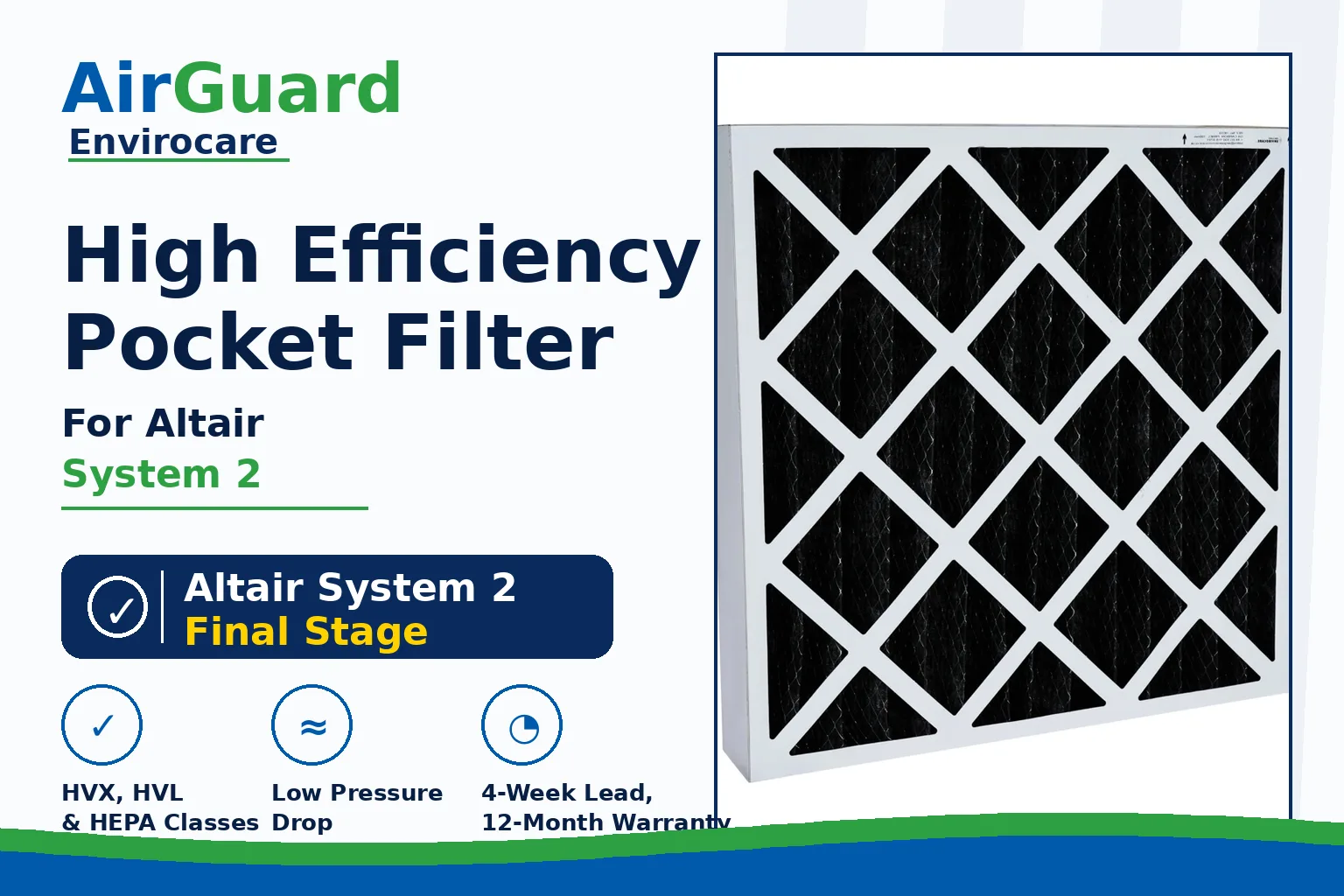
A high-efficiency pocket filter is the final filtration stage in a gas turbine intake system. Its job is simple: catch the tiny dust particles that make it past every earlier filter stage. The filter gets its name from its shape. Instead of a flat panel, the media is folded into deep pockets, which gives the filter much more surface area. More surface area means more dust-holding capacity and a longer service life before it needs changing.
These filters are rated by class. You will often see names like HEPA, HVX or HVL. Each class tells you how small a particle the filter can catch, and how efficiently it catches it. The full comparison of the classes is in the high-efficiency pocket filters guide; the short version is that HEPA is the highest efficiency class, HVX is built for standard gas turbine final-stage duty with low pressure drop, and HVL is built for longer service life with very high dust-holding capacity. There is no single best option. The right class depends on the site's air quality, the turbine's original specification, and how often the change-outs are scheduled.
How the final stage fits into the System 2 train
A pocket filter never works alone. In a System 2 intake it is the final stage in a system that usually looks like this:
Stage | Filter | Role in System 2 |
|---|---|---|
First stage | PBR pre-filter | Coarse dust, protects downstream stages |
Second stage | Coalescer panel | Moisture, salt aerosol, drainage |
Final stage | High-efficiency pocket | Fine dust, last barrier to compressor |
The pre-filter in a System 2 installation is typically the cleanable PBR pre-filter. Airguard's PBR-AG is specified as an OEM-equivalent pre-pocket filter for Altair System 2, Neptune and Vega applications, with high-velocity mechanical pre-filtration for offshore and coastal use. A cleanable pre-filter that is washed on schedule takes the bulk loading off the final stage — and a pre-filter that is neglected passes its load downstream, where the expensive final filter pays for it.
The coalescer stage removes moisture, salt mist and oil droplets before they reach the pocket filter. Skipping or weakening that stage puts more pressure on the final filter: a weak coalescer sends more moisture into the pocket filter, which shortens its life fast. That is why choosing the right final-stage filter starts with checking the whole system, not just the one filter being replaced.
Matching the final stage: HVX, HVL or HEPA?
The choice between classes is a specification decision, not a preference. The factors that decide it:
The original specification. The turbine's original System 2 configuration states the efficiency class. Do not downgrade the class to save on upfront cost: a lower class lets more fine dust through, which raises fouling risk over the filter's life — and the saving is usually lost later in reduced turbine efficiency and more frequent compressor washing.
Dust-holding capacity. A higher dust-holding capacity means fewer filter changes and less downtime. HVL is the option built for extended change-out intervals and very high dust-holding capacity; HVX balances efficiency with low pressure drop for standard final-stage duty.
Pressure drop. A filter with a lower starting pressure drop uses less fan energy and often lasts longer before it needs replacing. But pressure drop must be compared at the actual operating airflow, not at a catalogue figure: face velocity changes the behaviour, and the System 2 options differ in pressure loss at the same airflow. Ask for the pressure-loss curve.
Fit for the housing. Pocket filters need to seal tightly in the housing frame. Any gap lets unfiltered air bypass the media completely. The replacement must match the installed frame — face dimensions, pocket depth, gasket position — not just the nominal size.
Test data. A genuine high-efficiency filter should come with documented test results proving its rated efficiency class. Airguard manufactures HVX and HVL class pocket filters under ISO 9001-certified production, built to fit gas turbine housings including Altair System 2, Neptune, Vega and Aquila, and every filter is tested and documented to confirm its rated class before it ships.
Airguard's HV2-AG is an example from the range: a high-efficiency pocket filter with published airflow figures against face velocity for a 597 × 597 mm face, so the match can be checked against the installed housing rather than assumed.
When to change the final filter
Replacement timing depends on air quality and pressure-drop readings. A steadily rising pressure drop is the clearest sign a pocket filter has reached the end of its service life. Other signs the final stage needs review:
power output has slowly dropped with no obvious cause
compressor washing is happening more often than before
filter change intervals have gotten shorter over time
pressure drop is rising faster than expected
a recent reorder matched dimensions but the efficiency class was not reconfirmed
Replace on a schedule, not just on failure. Waiting for a visible problem usually means fine particles have already been reaching the compressor for some time. And plan around the lead time: four weeks is standard for made-to-order industrial filters, so the replacement should be ordered a full lead time ahead of the planned outage.
Common mistakes with System 2 final-stage replacements
These mistakes are common, and they are almost always avoidable with a proper specification check:
Downgrading the efficiency class to cut costs. A lower class filter costs less upfront but lets more fine particulate through, raising fouling risk over the filter's life.
Matching size without matching class. Two filters can look identical in size and shape but perform very differently depending on the media and rated efficiency class.
Ignoring the stages before it. A high-efficiency filter working behind a weak coalescer stage takes on extra moisture load, which shortens its service life fast.
Waiting too long between changes. A filter left in service past its rated life lets more fine particles through and raises pressure drop, which increases energy use.
Not asking for test documentation. Without documented proof of the rated class, there is no way to confirm the replacement matches the original specification.
How to order the right filter
Send the engineering team the current filter's part number, the System 2 configuration if known, the housing dimensions, and the operating environment. The team cross-checks the part number against the Altair cross-reference — 153 part numbers across 23 products — and confirms the correct HVX, HVL or HEPA class for the site. Parker / Altair equivalent Filters in this range are supplied as engineered replacements, not size-matched commodities, and every filter is tested and documented to confirm its rated efficiency class before it ships. The same process covers the whole intake train, so the pre-filter and coalescer can be matched in the same order. To start, send the part number — and request a free estimate for the filters the intake needs.
Wrapping up
The high efficiency pocket filter for Altair System 2 is the last chance to stop fine dust before it reaches the compressor. Get the class right — HVX for standard final-stage duty, HVL for extended intervals, HEPA where the specification demands it — make sure the stages in front of it are working, and verify the match on dimensions, class, media and pressure drop. The gas turbine intake filters guide sets out the whole train; this guide is the final stage done properly. And if the installed configuration is uncertain, send the part number and let the engineering team confirm it — a checked match is worth far more than a fast guess.
Further reading
FAQs
What is a high efficiency pocket filter for Altair System 2?
It is the final-stage filter in an Altair System 2 gas turbine intake: a pocket-folded filter that catches the fine dust particles that pass the pre-filter and coalescer stages, built to the System 2 configuration's efficiency class and dimensions.
What is the difference between HVX, HVL and HEPA?
HEPA is the highest efficiency class, catching nearly all fine particles. HVX is Airguard's high-efficiency pocket filter range built for standard gas turbine final-stage duty with low pressure drop. HVL is built for longer service life with very high dust-holding capacity. The right class depends on the original specification and the site's conditions.
How do I know which class my System 2 installation needs?
Check the turbine's original System 2 specification for the efficiency class, and confirm it against the installed filter's part number. Airguard's engineering team can cross-check the part number, turbine model or housing dimensions to confirm the correct class for the site.
Can I use a lower efficiency class to save money?
You can, but it raises the risk of fine dust reaching the compressor, which leads to fouling and power loss over time. Any saving on the filter is often lost later in reduced turbine efficiency and more frequent compressor washing.
How often should a System 2 final-stage filter be replaced?
Replacement timing depends on air quality and pressure-drop readings. A steadily rising pressure drop is the clearest sign the filter has reached the end of its service life. As a starting point, high-efficiency final filters last around 12 months, but coastal, dusty and continuously running sites shorten that. Order replacements a full lead time ahead of the planned outage.