
What Is a High-Efficiency Pocket Filter?
A high-efficiency pocket filter is the final filtration stage in a gas turbine intake system. Its job is simple: catch the tiny dust particles that make it past every earlier filter stage.
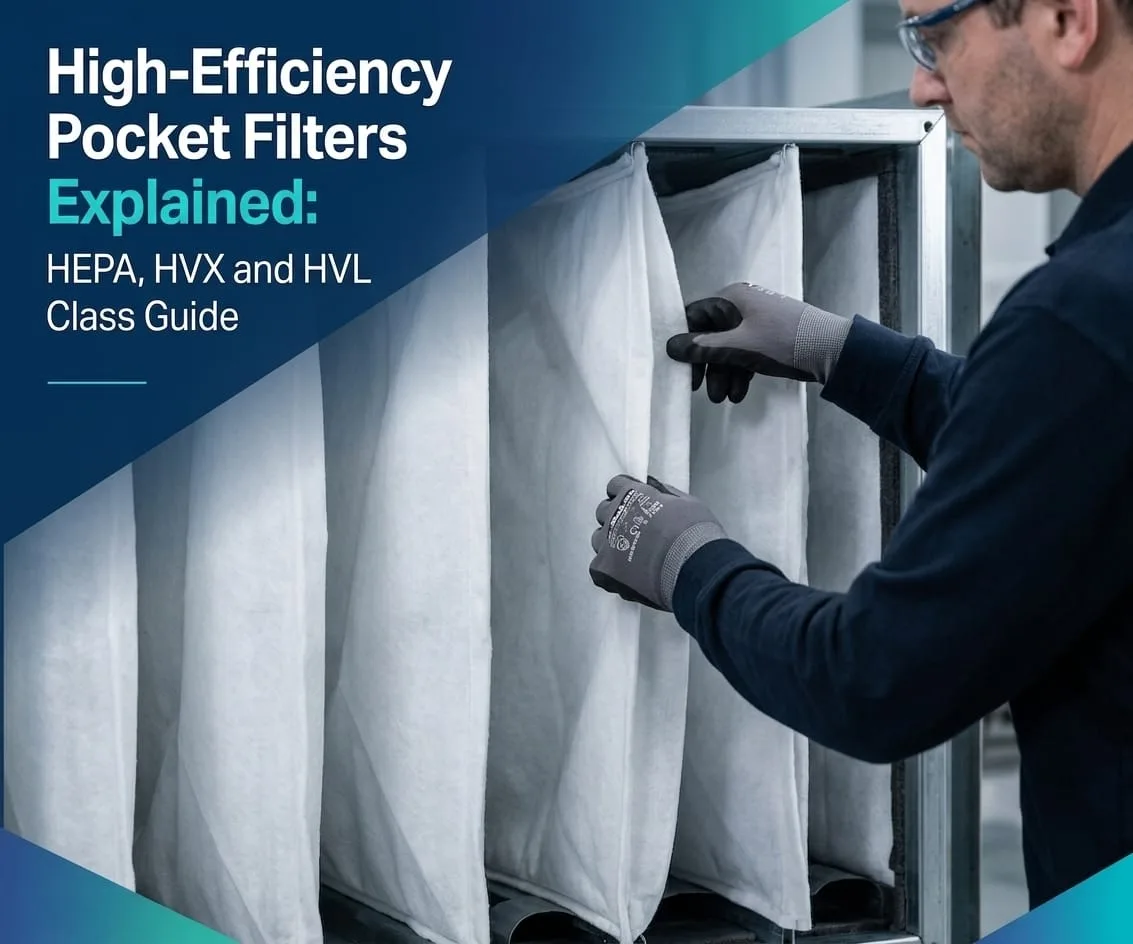
The filter gets its name from its shape. Instead of a flat panel, the media is folded into deep pockets. This gives the filter much more surface area. More surface area means more dust-holding capacity, and a longer service life before it needs changing.
These filters are rated by class. You'll often see names like HEPA, HVX, or HVL. Each class tells you how small a particle the filter can catch, and how efficiently it catches it.
Why Fine Particle Filtration Matters for Gas Turbines
Bigger dust particles are easy to stop. Coarse and coalescer filters handle most of that job. But very small particles are harder to catch. They can slip through gaps that larger particles can't.
Once fine dust reaches the compressor, it can:
Build up slowly on compressor blades, lowering airflow efficiency
Combine with any leftover moisture to form sticky deposits
Cause small, gradual power losses that add up over months
Increase how often the compressor needs washing
A strong final filter stage stops most of this before it ever becomes a problem.
Understanding Filter Efficiency Classes
Filter classes can be confusing at first. Here's a simple breakdown of what the common terms mean.
EN 1822 Classes (E10 to H14)
This European standard rates filters by how well they catch very small particles. E-class filters are efficient. H-class filters, often called HEPA, are even more efficient and catch nearly all fine particles.
ISO 16890 Classes
This newer global standard rates filters based on real particle sizes found in outdoor air, like PM1, PM2.5, and PM10. It gives a clearer picture of real-world performance.
HVX and HVL
These are Airguard Envirocare's high-efficiency pocket filter ranges, built to match the performance of industry-standard fine filters used in gas turbine housings. HVX and HVL filters are engineered for high dust-holding capacity with low pressure drop, so they protect the compressor without straining the fan system.
HEPA vs. HVX vs. HVL: Side-by-Side Comparison
Feature | HEPA Class (H13-H14) | HVX Class | HVL Class |
Efficiency level | Very high, catches nearly all fine particles | High, built for gas turbine intake duty | High, built for longer service life |
Best use case | Critical cleanroom-level air quality needs | Standard gas turbine final-stage filtration | Sites needing extended change-out intervals |
Pressure drop | Can be higher due to very fine media | Optimized for low pressure drop | Optimized for balance of life and efficiency |
Dust-holding capacity | Moderate | High | Very high |
Typical application | Power plants with strict air quality rules | Most land-based and offshore turbines | High-dust or long-runtime sites |
There's no single "best" option here. The right class depends on your site's air quality, your turbine OEM's original specification, and how often you want to schedule filter changes.
How High-Efficiency Pocket Filters Fit Into a Full Filtration System
A pocket filter never works alone. It's the final stage in a system that usually looks like this:
Coarse pre-filter - stops large debris and bulk dust
Coalescer panel filter - removes moisture, salt mist, and oil droplets
High-efficiency pocket filter - catches the fine dust left in the air
Skipping or weakening any one stage puts more pressure on the others. A weak coalescer stage, for example, sends more moisture into the pocket filter, which shortens its life. That's why choosing the right final-stage filter starts with checking the whole system, not just one part.
How to Choose the Right High-Efficiency Pocket Filter
1. Match the Efficiency Class to Your OEM Specification
Don't downgrade the class just to save on upfront cost. A lower class lets more fine dust through, which raises fouling risk over time.
2. Check the Dust-Holding Capacity
A higher dust-holding capacity means fewer filter changes and less downtime for maintenance.
3. Confirm the Pressure Drop Rating
A filter with a lower starting pressure drop uses less fan energy and often lasts longer before it needs replacing.
4. Verify the Fit for Your Housing
Pocket filters need to seal tightly in the housing frame. Any gap lets unfiltered air bypass the media completely.
5. Ask for Test Data
A genuine high-efficiency filter should come with documented test results proving its rated efficiency class.
Where High-Efficiency Pocket Filters Are Used Most
High-efficiency pocket filters protect equipment across several industries, not just gas turbines.
Power Generation
Land-based and offshore power plants rely on these filters to keep compressor blades clean over thousands of running hours. Even a small efficiency drop can mean a measurable loss in output across a full year.
Marine and Naval Propulsion
Ship and platform turbines need reliable fine filtration in tight spaces. High-efficiency pocket filters give strong protection without taking up excess room in the filter house.
Oil and Gas
Sites near processing plants deal with fine airborne particles alongside oil mist. A strong final filtration stage protects turbines running in these demanding environments.
Cleanroom and Critical Air Quality Applications
Some facilities need air quality that goes beyond turbine protection. HEPA-class filters are often specified here because of their very high capture rate for the smallest particles.
Common Mistakes When Specifying High-Efficiency Pocket Filters
These mistakes are common, and they're almost always avoidable with a proper specification check.
Downgrading the efficiency class to cut costs: A lower class filter costs less upfront but lets more fine particulate through, raising fouling risk over the filter's life.
Ignoring the stages before it: A high-efficiency filter working behind a weak coalescer stage takes on extra moisture load, which shortens its service life fast.
Matching size without matching class: Two filters can look identical in size and shape but perform very differently depending on the media and rated efficiency class.
Waiting too long between changes: A filter left in service past its rated life lets more fine particles through and raises pressure drop, which increases energy use.
Not asking for test documentation: A genuine high-efficiency filter should have documented proof of its rated class. Without it, there's no way to confirm it matches your original specification.
Maintenance Tips for High-Efficiency Pocket Filters
Keeping this final stage working properly is mostly about watching a few key signals.
Track pressure drops over time: A steady rise usually means the filter is loading up with fine dust and nearing the end of its service life.
Watch for uneven wear across pockets: This can point to an airflow or installation issue rather than the filter itself.
Confirm seals stay tight: Even a small gap around the frame lets unfiltered air bypass the media completely.
Replace on a schedule, not just on failure: Waiting for a visible problem usually means fine particles have already been reaching the compressor for some time.
Review your specification against turbine OEM requirements periodically: This keeps your filtration matched to the original design intent, not just whatever was ordered last time.
Signs Your Final-Stage Filter Needs Review
Power output has slowly dropped with no obvious cause
Compressor washing is happening more often than before
Filter change intervals have gotten shorter over time
Pressure drop is rising faster than expected
A recent reorder matched dimensions but the efficiency class wasn't reconfirmed
Why Choose Airguard Envirocare for High-Efficiency Pocket Filters
Airguard Envirocare manufactures HVX and HVL class pocket filters under ISO 9001-certified production, built to fit gas turbine housings including Altair® System 2, Neptune, Vega, and Aquila. Every filter is tested and documented to confirm its rated efficiency class before it ships. Our engineering team can cross-check your current part number, turbine model, or housing dimensions to confirm the correct class for your site, so your final filtration stage performs exactly as your turbine OEM intended.
Key Takeaways
High-efficiency pocket filters are the final filter stage, catching the smallest particles before they reach the compressor.
HEPA, HVX, and HVL are different efficiency classes, each suited to different site needs.
Pocket-style folding gives these filters more surface area, more dust capacity, and longer service life.
These filters depend on the coarse and coalescer stages working well upstream.
Never downgrade the efficiency class just to cut costs - it raises fouling risk over the filter's life.
Always confirm test data and fit before installing a "compatible" final-stage filter.
Conclusion
The final filter stage is your last chance to stop fine dust before it reaches the compressor. Getting the efficiency class right, and making sure it works with a strong coalescer stage before it, protects your turbine's power output for the long run.
Airguard Envirocare manufactures HVX and HVL class high-efficiency pocket filters, built and tested under ISO 9001-certified production, matched to gas turbine housings including Altair® System 2, Neptune, Vega, and Aquila.
Get your 24hr quote today and make sure your final filter stage is doing its job properly.
Frequently Asked Questions
What is the difference between HEPA, HVX, and HVL filters?
HEPA is a European efficiency class (H13-H14) known for catching nearly all fine particles. HVX and HVL are Airguard Envirocare's high-efficiency pocket filter ranges, built specifically for gas turbine intake duty, balancing efficiency with dust-holding capacity and pressure drop.
Why is my gas turbine losing power slowly over time?
Gradual power loss often points to fine particle buildup on the compressor blades. This usually means the final-stage filter isn't catching enough small particles, or an earlier stage like the coalescer isn't removing moisture properly.
How often do high-efficiency pocket filters need to be replaced?
Replacement timing depends on air quality and pressure drop readings. A steadily rising pressure drop is the clearest sign a pocket filter has reached the end of its service life.
Can I use a lower efficiency class to save money?
You can, but it raises the risk of fine dust reaching the compressor, which can lead to fouling and power loss over time. Any cost saved on the filter is often lost later in reduced turbine efficiency.
Do high-efficiency pocket filters work without a coalescer stage before them?
They can, but they won't perform as well or last as long. Without a coalescer stage removing moisture first, the pocket filter takes on extra load and wears out faster.
How do I find the right HEPA, HVX, or HVL filter for my turbine?
Send your current filter's dimensions, part number, or turbine model to our engineering team. We'll confirm the correct class and specification, then get your 24hr quote back to you fast.