
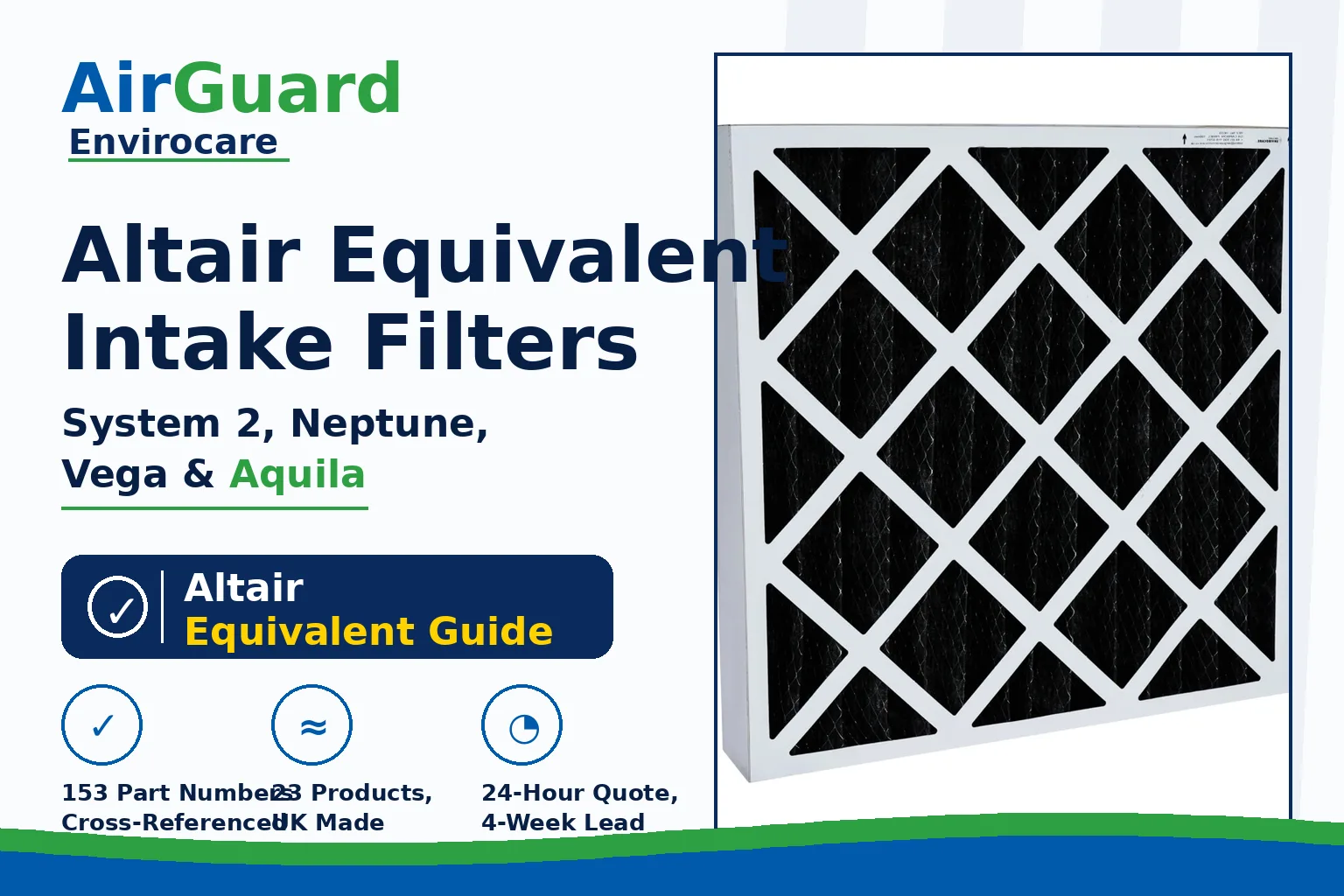
Parker's Altair filtration systems — System 2, Neptune, Vega and Aquila — protect gas turbines on power stations, offshore platforms and industrial sites around the world. When a filter in one of those systems needs replacing, the plant needs an Altair equivalent gas turbine intake filter: a replacement engineered to the original specification, cross-referenced to the Altair part number, and available without the original's lead time. Airguard Envirocare manufactures exactly that range in Wolverhampton, UK — 153 part numbers across 23 products, each cross-referenced to the Altair part it replaces. This guide explains how the Altair systems differ, how to find your match, and how to verify the replacement before it goes into the intake.
What "Altair equivalent" means
An Altair equivalent filter is a replacement filtration element designed to interface with air intake systems originally configured around Parker Altair filtration equipment. The word "equivalent" is doing the important work: the filter should not be selected solely because it physically fits the holding frame. The engineering comparison should consider the characteristics that influence intake-system performance — dimensions and depth, airflow, face velocity, initial pressure drop, filtration efficiency, dust-holding characteristics, media construction, frame construction, gasket and sealing arrangement, airflow direction, and moisture and salt exposure.
That is the standard Airguard works to. Each equivalent is cross-referenced to the Altair part number it replaces, so you can specify by the number you already use — and the engineering team can assess your existing Altair specification and produce a direct equivalent matched on dimensions, media and performance.
The four Altair systems, and why they are not interchangeable
Altair System 2, Neptune, Vega and Aquila are related but distinct systems, and a filter for one is not automatically right for another. Treating them as interchangeable is the most common mistake in Altair replacement procurement.
Altair System 2 is a high-velocity gas turbine intake filtration platform designed for demanding environments, including offshore and coastal installations. Parker's documentation identifies a cleanable PBR pre-filter and
three disposable high-efficiency bag-filter options within the System 2 range, with different efficiency and pressure-loss characteristics between options such as HVL, HVX and HVY. The system is designed around high airflow, dust-holding capacity, salt removal and pressure-loss considerations — which is why the replacement must be matched stage by stage, not by size alone.
Altair Neptune installations need similar attention to staged filtration, particularly where the intake operates in coastal, marine or contaminated environments. Several Airguard products are identified as compatible with Altair System 2, Neptune and Vega together, including pre-filters, coalescer panels and high-efficiency pocket filters — but compatibility with the system family does not eliminate the need to select the correct filtration stage.
Altair Vega configurations vary according to the required intake protection. Parker documentation describes Vega arrangements involving vane separation and filter coalescing, including configurations designed to handle airborne water, sea spray and fine droplets, for gas turbine, diesel-engine and HVAC applications. The filter cannot be evaluated independently of the air-intake architecture.
Altair Aquila should be treated as a separate system reference during specification rather than assuming that every System 2, Neptune or Vega filter is automatically interchangeable. Airguard identifies its Altair-compatible range as covering System 2, Vega, Neptune and Aquila — but the engineering process remains the same for each: identify the installed configuration, establish the filter specification, verify physical compatibility, confirm performance requirements and review environmental conditions.
Finding your match: the part-number route
The fastest route to the right equivalent is the part number. Airguard's OEM Part Number Guide and the Altair hub page list every cross-reference: find your Altair part number and it shows the matching Airguard filter. The hub covers 153 part numbers across 23 Airguard products, including:
Airguard product | What it is | Altair systems |
|---|---|---|
CP2-AG | Coalescer panel filter | System 2, Neptune, Vega |
PBR-AG | Pre-pocket filter | System 2, Neptune, Vega |
PFA-AG | Panel filter | Vega |
HV2-AG | High-efficiency pocket filter | System 2 family |
HVL-AG / HVX-AG | High-efficiency pocket filters | System 2 family |
GT2-AG | Gas turbine intake filter | System 2 family |
If your part number is not listed, send it to the engineering team with the dimensions and the system name. The team assesses the existing specification and produces a direct equivalent matched on dimensions, media and performance — including bespoke sizes where the installed housing is non-standard. Quote requests are answered within 24 hours.
Staging: the filter's job depends on where it sits
A major mistake in replacement procurement is treating every filter in the intake system as performing the same job. A staged filtration system uses different elements to manage different contaminant types, and the gas turbine intake filters guide sets out the full train. In an Altair system the stages are:
Pre-filter: removes larger contaminants and reduces the loading on downstream filtration. Airguard's PBR-AG is specified as an OEM-equivalent pre-pocket filter for Altair System 2, Neptune and Vega applications, with high-velocity mechanical pre-filtration for offshore and coastal use.
Coalescer: manages moisture and liquid aerosol, draining them away before they reach the final stage. The CP2 coalescer panel filter combines coalescing and mechanical filtration for offshore, marine and land-based installations.
High-efficiency final: captures fine particulate. The high efficiency pocket filter for Altair System 2 is covered in its own guide — the final stage deserves its own specification check, because its efficiency class decides what reaches the compressor.
A pre-filter, a coalescer and a high-efficiency pocket filter perform different functions. Ordering the wrong stage — even from the right system family — leaves the turbine unprotected in exactly the place the original design was protecting it.
Verifying the replacement before it goes in
Before an Altair equivalent goes into the intake, verify it the same way you would verify any OEM-equivalent replacement:
Dimensions: face size, depth, pocket depth, frame, gasket location and holding-frame interface — a filter a few millimetres out will not seal, and an unsealed filter is a bypass path.
Efficiency: the rated class and the test method behind it. A class without test documentation is an assertion, not a specification.
Pressure drop: the pressure-loss curve across the operating airflow range, not a single number. Different System 2 configurations have different pressure-loss and efficiency characteristics, so the curve is part of the match.
Media and construction: media type, frame material, support construction, gasket material and seal configuration — and for the coalescer stage, how the media handles water.
Environment: coastal, offshore, dusty or humid. An equivalent for a land-based installation may not be the right choice for a marine one.
For EPC projects, these parameters belong in the technical submittal rather than relying solely on an "Altair equivalent" description. The full EPC checklist is in the Altair equivalent filters buyer's guide, which is the authority page for this cluster.
Why plants switch to Parker / Altair equivalent Filters
The installed base of Altair systems is large, the original systems are well documented, and the equivalent range is mature — which is why Parker / Altair equivalent Filters are the most-specified OEM-equivalent replacement in gas turbine intakes. Plants switch for three practical reasons: availability (a UK manufacturer answering quotes in 24 hours and delivering made-to-order filters on a four-week lead time, instead of a single-source queue), consistency (the same equivalent, reproduced to the same specification, across the project lifecycle), and engineering support (a team that assesses the existing specification rather than selling a size). The saving is real only if the equivalent performs — which is why every claim in this guide comes back to verification: part number, dimensions, class, media and pressure drop, in writing, before the order.
Wrapping up
An Altair equivalent gas turbine intake filter is not a generic replacement with an Altair label. It is a filter engineered to the original Altair specification for a named system — System 2, Neptune, Vega or Aquila — at a named stage, cross-referenced to the original part number, and verified on dimensions, efficiency, media and pressure drop. Find your part number on the Altair hub, check the stage, verify the specification, and order with the match on file. To start, send the Altair part number and the system name — and request a free estimate for the filters the intake needs.
FAQs
What is an Altair equivalent gas turbine intake filter?
It is a replacement filter manufactured to match a Parker Altair filtration system — System 2, Neptune, Vega or Aquila — engineered to the original specification on dimensions, efficiency class, media and pressure drop, and cross-referenced to the Altair part number it replaces.
How do I find the right Altair equivalent for my part number?
Find your Altair part number in Airguard's OEM Part Number Guide or on the Altair equivalent filters hub, which lists 153 part numbers across 23 products. If your number is not listed, send it with the dimensions and system name and the engineering team will identify the match.
Are Altair System 2, Neptune, Vega and Aquila filters interchangeable?
No. They are related but distinct systems, and a filter for one is not automatically right for another. Always confirm the system and the filtration stage — pre-filter, coalescer or high-efficiency final — before ordering.
Which Airguard products are Altair equivalents?
Examples include the CP2-AG coalescer panel filter, the PBR-AG pre-pocket filter, the PFA-AG panel filter, and the HV2-AG, HVL-AG and HVX-AG high-efficiency pocket filters. The full cross-reference is on the Altair equivalent filters hub page.
How quickly can I get an Altair equivalent filter?
Quote requests are answered within 24 hours, and the standard lead time for made-to-order industrial filters is four weeks. Send the part number and specification early so the change-out is never delayed by delivery.