
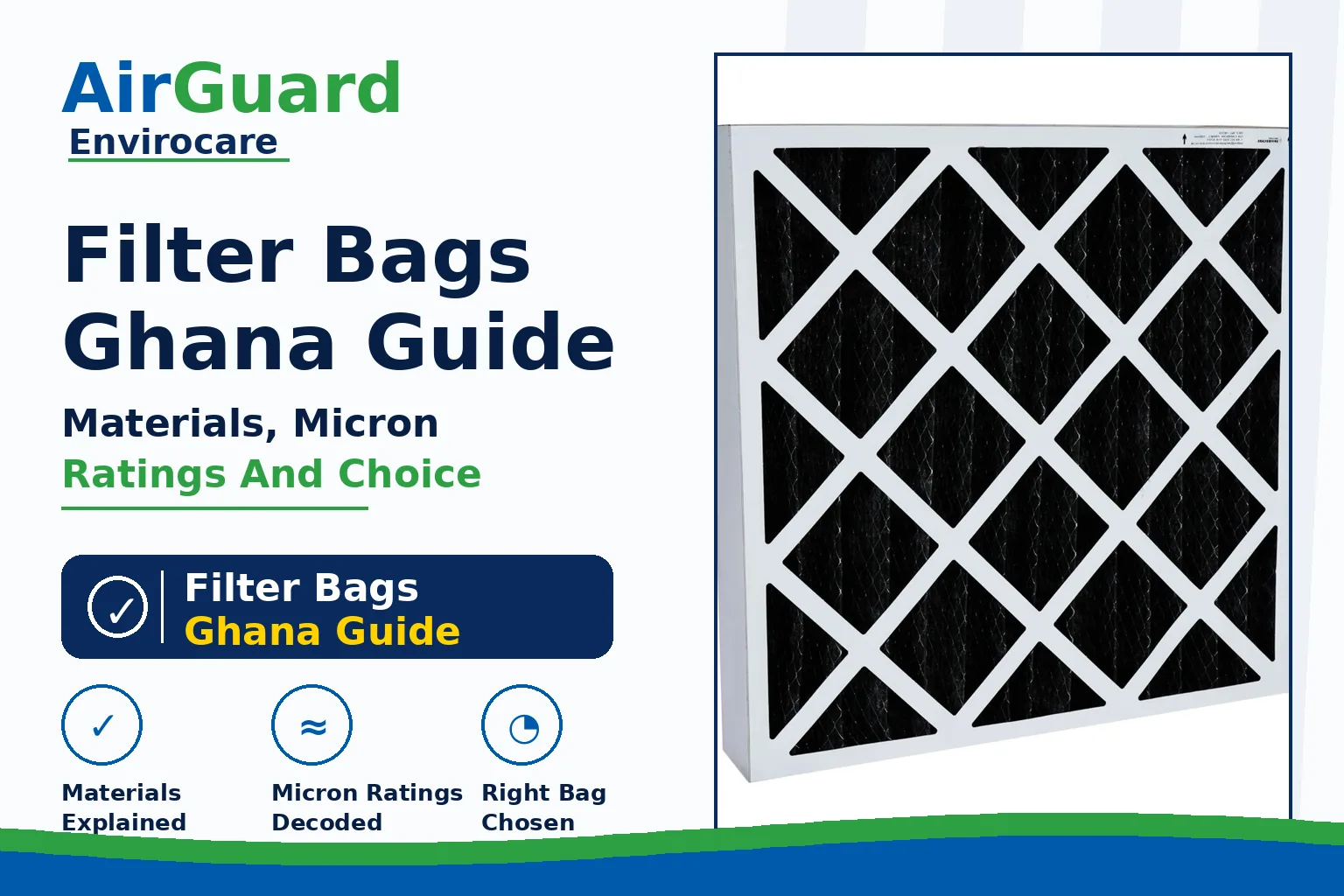
A filter bag is the working part of a bag filter: the pocket of media that does the catching, sewn to a frame and hung in the airstream. Buyers often talk about bag filters as a whole, but the choices that decide performance are made at the level of the bag itself — its material, its micron rating, its size and its construction. This guide explains those choices in plain terms, for buyers in the Ghanaian market who need to select a filter bag for a commercial building, a factory or a plant, and who want to judge a supplier's offer on its merits rather than on its price alone.
What a filter bag is
A filter bag is a pocket of filter media, open at the frame end and closed at the far end, that hangs downstream of its frame in the direction of airflow. Air enters through the open face and passes through the media walls of the bag. Dust is caught on and in the media, and clean air leaves through the far side. Several bags are usually mounted on one frame, and the set of bags together with the frame is what is sold as a bag filter. The bag is therefore the unit that matters: its material decides what it can catch and what it can tolerate, its micron rating describes the size of particle it is aimed at, and its depth and count decide how much media area the filter has.
The frame matters too, because it is what seals into the housing tracks. A frame that is bent or out of square will not seal, and air will bypass the bags around its edges. But the performance questions — what the bag catches, how long it lasts, how its resistance rises — are questions about the bag and its media.
Materials: what filter bags are made from
Filter bags are made from several kinds of media, and the material decides how the bag behaves in heat, moisture and chemical exposure. Synthetic media, commonly polyester-based, is widely used in HVAC bag filters because it holds its shape and tolerates moisture well. Glass fibre media is used where finer capture is needed, and it appears in higher-grade pocket and bag filters. Some media is treated to resist moisture, and carbon-loaded media is used where odour control matters as well as particle capture.
The material choice follows the duty: a bag in a humid or coastal environment needs media that tolerates moisture without sagging, and a bag in a hot airstream needs media that holds its shape at the operating temperature. A buyer should be able to ask the supplier what the media is and whether it suits the site's conditions — and should be cautious of a supplier who cannot answer.
Micron ratings: what they mean and what they do not
A micron is a millionth of a metre, and a micron rating describes the size of particle a filter bag is aimed at catching. A finer micron rating means the bag is aimed at smaller particles. That is the useful part of the rating. The part that needs care is what a single micron figure does not say. It does not say how much of the dust at that size the bag catches, it does not say how the bag behaves as it loads, and it does not say how long the bag will last before its pressure drop reaches the change point. Two bags with the same micron figure can behave very differently, because their media, their fibre structure and their dust-holding capacity differ.
The honest way to read a micron rating is as one figure among several, alongside the efficiency class, the media area and the pressure-drop behaviour. The efficiency classes used in HVAC work — F6, F7, F8 and F9, in rising order of fineness — already describe the class of the finished filter, and they are the better guide to selection. A F6 bag filter suits ordinary commercial ventilation, a F7 bag filter is the common final filter in air handling units, a F8 bag filter suits higher air-quality requirements, and a F9 bag filter is the finest of the four.
How a filter bag works
A filter bag works by capture on its media. Larger particles strike the fibres directly and stick. Smaller particles are caught by interception as they pass close to a fibre, and the finest particles wander until they touch a fibre and stick. As dust builds up it forms a cake on the media surface, and that cake itself becomes part of the filter, catching finer particles than the clean media alone would.
The same loading raises resistance. Every filter has a clean pressure drop when new and a final pressure drop at which it should be changed. As the dust cake thickens, the pressure drop climbs, slowly at first and then more steeply, and the fan must work harder to move the same volume of air. The right change point is therefore the final pressure drop, read from a gauge across the filter, not the appearance of the media and not the calendar alone.
Sizing a filter bag
Sizing a filter bag means matching three dimensions: the face size of the frame, the depth of the bags, and the number of bags on the frame. The face size is measured from the existing filter or the housing opening, and it must match exactly — a frame that is too small leaves a bypass gap around its edges. The bag depth must fit the space available downstream of the frame, with the bags hanging freely and clear of each other and the housing walls.
The bag count and depth together decide the media area, and the media area decides how much dust the filter can hold before its pressure drop reaches the change point. More and deeper bags mean more area and longer life, but they also need a deeper housing. The table below sets out the sizing checks a buyer should make before ordering.
Check | What to confirm | Why it matters |
|---|---|---|
Face size | Measure the existing filter and housing | A wrong size leaves a bypass gap or will not fit |
Bag depth | Bags hang free, clear of the housing | Crushed bags underperform from day one |
Bag count | More bags mean more media area | More area means longer life at the same dust load |
Efficiency class | F6, F7, F8 or F9, per the system design | Wrong grade cuts airflow or leaves the coil exposed |
Construction | Soft pocket or rigid bag | Rigid suits cycling and variable-speed fans |
Pre-filter stage | G4 panel ahead of the bag filter | Protects the bag and extends its life |
Original part number | Match the replacement to the original | Exact match in dimensions, class and media |
A rigid bag, such as a F7 rigid bag, has a rigid frame that keeps the bags in shape even when the fan cycles on and off or airflow varies, which suits systems with variable-speed fans or intermittent running. A soft pocket bag relies on airflow to hold its bags open and suits systems that run continuously at steady airflow.
Choosing a filter bag: a buyer's routine
Choosing a filter bag starts with five facts: the face size and depth the housing takes, the efficiency class the system was designed around, the bag material and construction, the quantity needed, and the operating environment — dust load, running hours, humidity and any coastal salt or corrosive load. With those, a supplier can match the exact bag the system needs. If the bag replaces an existing filter, the original part number identifies the exact dimensions, class and construction, and Airguard's specification matching service matches a replacement to that original part number, including OEM-equivalent replacements.
For buyers in Ghana, the same discipline applies as anywhere else: the bag must match the system it serves, and the supplier should be able to match a replacement to the original part number and to state the lead time and warranty in writing. Airguard is a UK manufacturer of industrial and HVAC filters, supplying panel, pocket and bag filters, coalescer panels and high-efficiency pocket filters, with a four-week lead time on made-to-order filters and a 12-month manufacturing warranty. A buyer should also ask about continuity of supply — whether the same bag can be provided again next time, so the site standardises on one matched replacement instead of buying whatever is available each time.
Staging belongs in the choice too. A coarse pre-filter — typically a G4 panel filter — sits ahead of the bag filter and takes the first load of dust. The bag behind it then works on the finer dust that passes the pre-filter, and its life is much longer than it would be on its own. Sites that skip the pre-filter stage to save money almost always pay more in bag replacements.
Fitting, maintenance and replacement
A filter bag is fitted by sliding the frame into the housing tracks with the bags hanging downstream, in the direction of the airflow arrow on the frame. Check that the bags hang freely, without touching each other or the housing walls, and that the frame seals all round. Check the gaskets and the tracks at the same time: a new bag in a leaking housing protects nothing.
Maintenance is mostly inspection and record-keeping. At each routine visit, read the pressure drop across the filter and compare it with the final pressure drop for the system. Look at the bags for tears, damp patches, sagging or media pulling away from the frame. Any of these means replace immediately, because a damaged bag is not filtering. A bag that is wet should be replaced too, since wet media loses strength. Record the date and the reading each time, so that after a year the right interval for that site is visible in the records rather than guessed.
Replacement timing follows the same rule as everywhere: change on pressure drop, not on habit. A bag filter in a commercial air handling unit typically lasts six to twelve months, depending on dust load, running hours and environment, but the calendar is only a backstop. A building beside a busy road or a construction site will load bags faster than one in a clean area, and a system that runs around the clock ages its bags faster than one that runs a single shift. Keep a small stock of the bags the site uses most, so a changeout is never delayed because the bag is on a four-week lead time. The companion guide to air filter replacement sets out the changeout routine in full.
Mistakes that cost money
Chasing the finest micron rating available without reference to the system design, and ending up with a bag that loads too fast and is changed too often.
Fitting the wrong grade — finer than the fan can handle, or coarser than the air quality needs.
Skipping the pre-filter stage.
Fitting a bag into a housing too shallow for its depth, so the bags crush and the filter underperforms from the first day.
Buying on price alone without checking that the replacement matches the original in dimensions, class, bag count and media.
For a firm recommendation on your filter bags, request a free estimate with the filter details — the estimate is free, and it is based on the exact filter your system needs.
Frequently asked questions
What is a filter bag?
A filter bag is a pocket of filter media, open at the frame end and closed at the far end, that hangs downstream of its frame in the airstream. Several bags mounted on one frame form a bag filter. The bag's material, micron rating, size and construction decide how it performs.
What does a micron rating mean for a filter bag?
A micron rating describes the size of particle the bag is aimed at catching — a finer rating means smaller particles. It does not on its own say how much dust at that size the bag catches, how it behaves as it loads, or how long it lasts, so read it alongside the efficiency class and the media area.
Which filter bag material should I choose?
It depends on the duty: synthetic media is widely used in HVAC bags for its shape and moisture tolerance, glass fibre media appears in finer grades, and carbon-loaded media suits odour control. Ask the supplier what the media is and whether it suits the site's heat, moisture and chemical exposure.
How long does a filter bag last?
Typically six to twelve months in a commercial air handling unit, depending on dust load, running hours and environment. The proper trigger is the final pressure drop, not the calendar alone.
Can a filter bag be washed and reused?
No. Most filter bags are disposable, and washing damages the media and changes its efficiency. A damaged, damp or torn bag should be replaced, not cleaned.
Wrapping up
A filter bag is a small thing with a large effect on the air system it serves. Its material decides what it can tolerate, its micron rating describes the particle size it is aimed at, and its size and construction decide how much dust it can hold before it must be changed. Read the micron rating alongside the efficiency class, match the bag to the system design, stage a pre-filter ahead of it, fit it so the bags hang free, and change it on pressure drop. Done that way, the filter bag stops being a consumable bought on price and becomes what it should be: a planned part of the air system, matched to the site it serves.
References
F6 bag filter — https://airguardenvirocare.com/products/f6-bag-filter
F7 bag filter — https://airguardenvirocare.com/products/f7-bag-filter
F8 bag filter — https://airguardenvirocare.com/products/f8-bag-filter
F9 bag filter — https://airguardenvirocare.com/products/f9-bag-filter
G4 panel filter — https://airguardenvirocare.com/products/g4-panel-filter
F7 rigid bag — https://airguardenvirocare.com/products/f7-rigid-bag
Ghana — https://airguardenvirocare.com/gh
air filter replacement — https://airguardenvirocare.com/insights/air-filter-replacement-guide
reading the pressure drop curve: a practical guide for plant engineers — https://airguardenvirocare.com/insights/reading-the-pressure-drop-curve-a-practical-guide-for-plant-engineers
request a free estimate — https://airguardenvirocare.com/request-pricing
specification matching — https://airguardenvirocare.com/services/specification-matching