
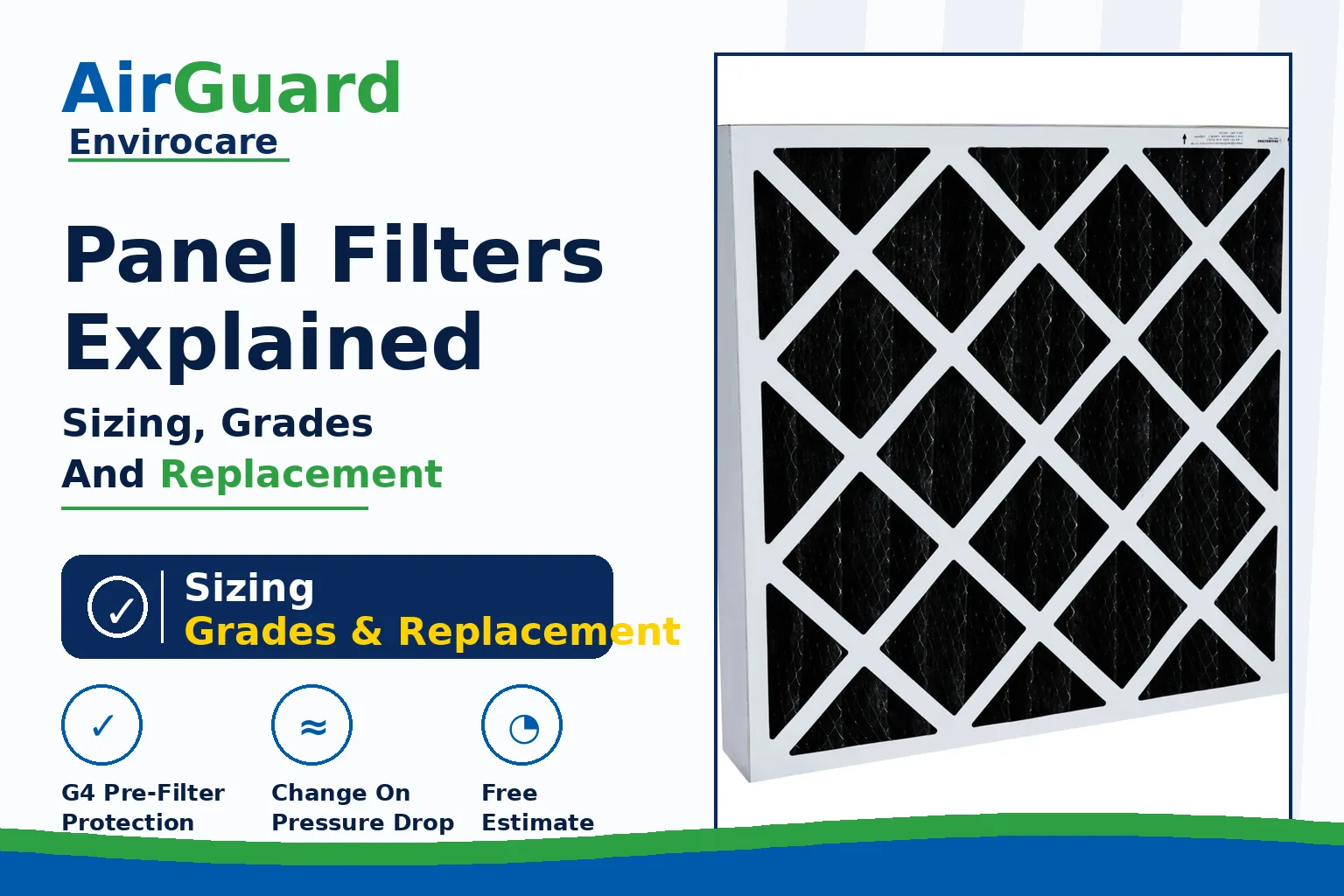
The panel filter is the simplest filter in industrial and commercial air filtration — a flat sheet of media held in a frame — and also the most widely used. It is the first stage in most air handling systems, the pre-filter that protects everything behind it, and the filter that is changed most often. Because it looks simple, it is easy to treat as a commodity and buy on size and price alone. That is a mistake. The media, the grade, the frame and the fit all decide whether a panel filter protects the system or merely occupies the housing. This guide explains panel filters for buyers in Ghana and elsewhere: how sizing works, what the grades mean, and when to replace them.
What a panel filter is
A panel filter is a flat filter: media pleated or laid flat in a frame, usually metal or board, that slides into a housing or filter bank. Air passes through the media, dust is captured on and in the fibres, and clean air leaves on the other side. The panel has no pockets, no pleated depth to speak of, and no moving parts. Its simplicity is its strength: it is easy to fit, easy to inspect, easy to change, and inexpensive compared with the filters behind it.
That simplicity also defines its role. A panel filter is a pre-filter. It catches the larger dust — the coarse particles that would otherwise load the finer filters behind it — and it does so at a low pressure drop. A bag filter or a high-efficiency pocket filter behind it then catches the finer dust. The panel filter is changed more often and costs less; the final filter lasts longer. Panel filters are used in commercial and industrial HVAC, in air handling units, in turbine intake houses as a first stage, and in spray booths and process ventilation. The form is the same everywhere. What changes is the media, the grade and the frame, and those three things follow the application.
Grades: G4, F7 and the classes between them
Panel filters are supplied in efficiency classes, and the class is the most important fact about the filter. The G4 panel filter is the common pre-filter class: it captures coarser dust, holds a good dust load, and keeps its pressure drop low. The F7 panel filter is a finer panel class, used where the panel itself must do more of the filtration work. Between and around them sit other classes, and the choice should follow the application rather than habit.
A higher class is not automatically better. A finer panel loads faster in dusty air, reaches its final pressure drop sooner, and needs changing more often. Where the panel is a pre-filter ahead of a bag stage, G4 is usually the right choice: it catches the coarse dust, lets the finer dust through to the bag filter that is designed for it, and lasts long enough to be economical. Where the panel is the only filter in the system, a finer class may be needed. The question to ask is not which class is best in the abstract, but which class the system was designed around. The original specification, or the original part number, will say.
Carbon panel filters are a separate case. A carbon panel filter carries activated carbon in its media, and it removes odours and gases as well as dust. It is used where the air carries smells, fumes or vapours that a dust filter cannot touch — kitchens, workshops, process areas, and buildings near industrial sources. A carbon panel loads differently from a plain dust panel: its odour capacity is used up by exposure, not just by dust, and it needs changing on a schedule that reflects the odour load as well as the pressure drop.
Sizing a panel filter
Sizing a panel filter starts with the housing. Measure the housing, not the old filter, because an old filter may have distorted, shrunk or swollen with moisture. Record the width, height and depth, the frame thickness, and the way the filter is held — slides, clips, a holding frame, or a simple slot. A panel filter that is a few millimetres out will not seal, and air will bypass it through the gap. The bypass air carries its dust straight through to the final filter, the coils and the rooms beyond, so a badly fitting panel filter protects nothing.
Depth matters too. A panel filter is usually shallow, but the depth must match the housing's slot or frame. A filter too deep will not seat properly; a filter too shallow will rattle, leak at the edges, or fall out of the holding frame. If the filter is a replacement for an original part, the original part number is the surest route to the right size, and a supplier that matches replacements to the original part number will get the size right first time.
Airflow is the other half of sizing. A panel filter must be sized to the system's design airflow: too small, and the air velocity through the media is too high, pressure drop climbs quickly, and the filter reaches its final pressure drop early. Most panel filters are used in banks, with several filters side by side making up the full face area of the air handling unit. The number of filters, their size and the design airflow together decide the face velocity, and the face velocity decides how the filter performs. A supplier that asks for the airflow and the housing dimensions before quoting is doing the job properly.
Panel filters in Ghanaian conditions
Ghana's climate shapes the life of a panel filter. Heat and humidity load filters with moisture as well as dust, and a filter that stays damp can lose strength and encourage microbial growth. The harmattan season brings fine dust across much of the country, and construction dust, traffic dust and industrial dust add to the load in towns and cities. Coastal sites carry salt, which corrodes frames and housings. The result is that a panel filter in Ghana will usually reach its final pressure drop faster than the same filter in a cooler, cleaner climate, and the replacement schedule should be built around that.
For buyers in Ghana, this guide is written as buyer guidance for the market rather than a claim about local supply. The site's Ghana page is a general introduction, and the practical step for any Ghanaian buyer is to confirm the specification, the lead time and the delivery arrangement with the supplier before ordering. A four-week lead time is standard for made-to-order filters, so orders should be placed ahead of the changeout, and a small stock of the filters the site uses most should be kept on hand.
Replacement: when and how
The proper trigger for replacing a panel filter is the final pressure drop — the resistance at which the filter should be changed, set by the system designer or the filter supplier. A differential pressure gauge across the filter bank gives the reading directly. When the reading reaches the final pressure drop, the filter is done, whatever the calendar says. Visual inspection is the second check: tears, holes, damp patches, a sagging or distorted frame, or media pulling away from the frame all mean replace immediately. The guide to air filter replacement covers the changeout steps in full.
The table below gives starting points for a typical site. Treat them as the basis for a site-specific schedule, not as rules.
Panel filter type | Typical replacement interval | What shortens it |
|---|---|---|
G4 panel pre-filter | 3 to 6 months | High dust, harmattan, continuous running |
F7 panel filter | 6 to 12 months | Heavy loading, humid air, coastal salt |
Carbon panel filter | 3 to 6 months | Odour load, humidity, chemical exposure |
Panel ahead of a bag stage | 3 to 6 months | Acts as the sacrificial first stage |
Panel as the only filter | 3 to 6 months | Carries the full dust load alone |
A good changeout is quick but not careless:
Isolate the fan or shut the unit down so the filter is not changed under suction.
Remove the old filter without shaking it over the clean side.
Inspect the housing, clean the tracks, and check the gaskets and seals.
Fit the new filter the right way round, following the airflow arrow on the frame.
Check the seal all round the frame, record the date and the pressure drop, then restart.
Choosing between panel and bag
A common question is whether to use a panel filter or a bag filter. The answer is usually both, in stages. The panel catches the coarse dust at low cost and low pressure drop. The F7 bag filter behind it catches the finer dust with its much larger media area. A system that uses a panel alone will pass fine dust through to the coils and the rooms. A system that uses a bag filter alone will load the expensive bag with coarse dust it was not designed for. The two-stage arrangement is the standard for a reason: each filter does the job it is best at, and the combination lasts longer and costs less than either filter alone.
The guide to the types of air filters covers the full range of filter forms, and it is a useful companion to this guide when planning a filter bank. The key point is that the panel and the bag are partners, not alternatives, and the panel's job is to protect the bag.
What to ask a supplier
Compare quotes only when they are for the same filter. A quote far below the rest usually means something is different: a lower class, a thinner media, or a frame that only approximates the size. Ask the low bidder to confirm each element of the specification. If the specification matches and the price is genuinely lower, the saving is real. If it does not, the saving will be paid for in energy, changeouts or downstream damage.
For a firm quote on the exact filter your system needs, request a free estimate with the filter details — the estimate is free, and it is based on the specification, not a guess.
Wrapping up
Panel filters are simple, cheap and easy to change — and that is exactly why they are easy to get wrong. The right panel is the right size for the housing, the right grade for its place in the system, and the right media for the site's dust, humidity and salt. Changed on pressure drop, inspected at every changeout, and kept in stock against the lead time, a panel filter does the quiet job it was designed for: catching the coarse dust, protecting the expensive filters behind it, and keeping the whole system running at the pressure drop it was designed for. Get the panel right, and everything behind it lasts longer.
FAQs
What is a panel filter used for?
A panel filter is the first stage in most air handling systems. It catches coarser dust at low pressure drop and protects the finer filters, coils and equipment behind it. It is changed more often and costs less than the final filter.
What is the difference between a G4 and an F7 panel filter?
G4 is the common pre-filter class for coarser dust, while F7 is a finer panel class that captures smaller particles. G4 is usually the right choice ahead of a bag stage; F7 suits systems where the panel must do more of the filtration work.
How do I size a panel filter?
Measure the housing, not the old filter, and record the width, height and depth, the frame thickness and the holding arrangement. If it is a replacement, the original part number is the surest route to the right size.
How often should panel filters be replaced?
When the pressure drop reaches the final pressure drop set for the system, or when inspection shows damage. G4 pre-filters typically last 3 to 6 months, and F7 panels 6 to 12 months, but dust load, humidity and running hours change the interval on every site.
Can a panel filter be washed and reused?
Most panel filters are disposable and should not be washed — washing damages the media and changes its efficiency. Only filters specifically designed as washable should be cleaned, and only by the manufacturer's method.