
Introduction
The panel filter is the most common industrial air filter in the world, and the most underestimated. A filter panel — a flat sheet of media held in a rigid frame — is the first filter the air meets in most systems, and it does the job that makes every filter behind it last longer. This guide explains the types of filter panel, the grades they come in, where they are used in industry, and how to choose and change one.
What a filter panel is
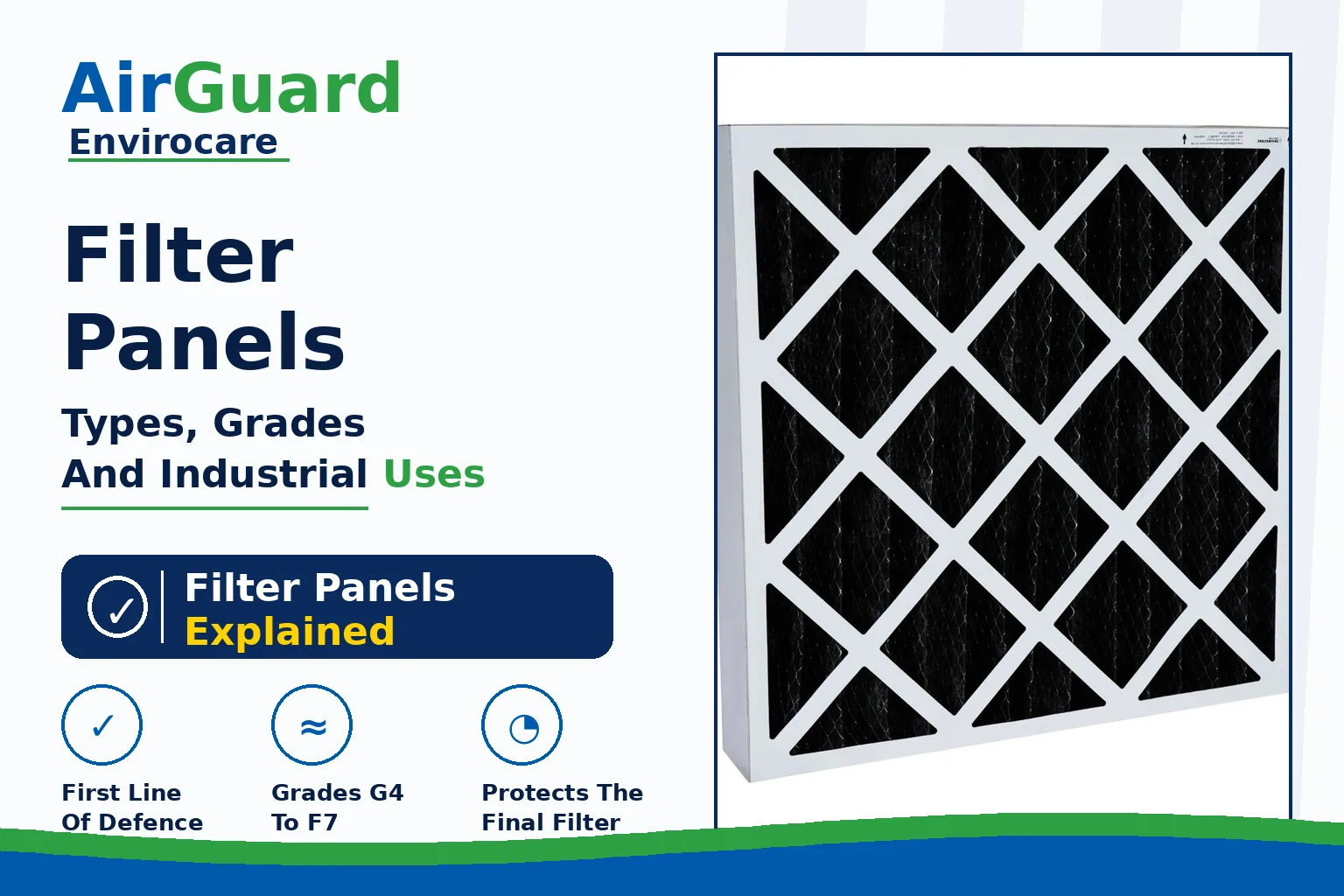
A filter panel is a flat filter: a sheet of media, usually pleated to increase its surface area, held in a frame of metal, card or plastic. Air passes through the media, dust is held on and within the fibres, and the frame holds the media in shape and seals it into the housing. The design is simple, and that simplicity is the point: a panel filter is cheap, easy to fit, easy to change, and easy to keep in stock.
The pleats matter. A flat sheet has only its face area to work with, and it loads quickly. Pleating folds far more media into the same frame, so the panel holds more dust and lasts longer before its pressure drop rises to the changeout limit. The depth of the pleat, the spacing and the media all decide how the panel behaves — which is why two panels of the same size and grade can perform differently, and why a true equivalent match matters.
Types of filter panel
The most common type is the pleated synthetic panel, made from synthetic fibres formed into pleats and held in a rigid frame. It is the standard pre-filter for HVAC and industrial air handling, catching coarse dust before it reaches the finer stages. The G4 panel filter is the usual example: a general-purpose panel for pre-filtration in air handling units, turbine intakes and industrial ventilation.
The F7 panel filter steps up to finer dust for systems that need cleaner supply air from a panel construction. It suits air handling units where space or housing design calls for a panel rather than a bag, and it is also used as a secondary stage behind a G4 pre-filter.
The carbon panel filter adds a layer of activated carbon to a panel construction, so it removes odours and gases as well as dust. It is used where smell or chemical vapour is the problem — in kitchens, waste handling, chemical stores and process areas — and it is always fitted with a dust stage in front of it, because dust loading blinds the carbon layer.
The glass panel filter is a simple, economical coarse filter made from glass fibre media, used for general ventilation where the dust load is light and the budget is tight. And the high-loft panel, such as the G4 high-loft filter, uses a thick, fluffy media that holds a large amount of coarse dust — useful as a first stage in dusty environments where a standard panel would load in days.
Grades: what G4 and F7 mean
Filter panel grades describe how fine the dust is that the panel captures. G4 is a coarse grade: it catches the large particles — visible dust, lint, insects, fibres — that load a system fastest. F7 is a finer grade: it catches the smaller dust that fouls coils, dirties ductwork and reaches the rooms. The grade is chosen by what the air needs to be after the panel, and by what sits behind it.
A panel is usually the first stage, not the last. Its job is to catch the coarse dust so the finer filter behind it — a pocket and bag filter or a high-efficiency pocket filter — can do its job without being overwhelmed. Choosing the panel grade is therefore a system decision: a G4 panel in front of an F7 bag is the standard pairing, and it is the pairing that gives the bag its full service life.
Industrial uses of filter panels
In air handling units, the panel filter is the first stage, protecting the bag filter, the coil and the ductwork. In gas turbine intakes, panel filters serve as the pre-filter stage, catching the bulk dust before the high-efficiency final filters. In spray booths, panel filters are used as intake and exhaust stages, catching overspray and keeping the booth air clean. In process ventilation, panels protect fans, motors and process equipment from the dust in the airstream. In commercial buildings, panels are the workhorse filter in every air handling unit, changed more often than any other filter in the building.
The common thread is that the panel is the sacrificial stage. It is cheaper than the filter it protects, it loads first, and it is changed most often. That is its value: a panel changed on time is what lets the expensive final filter reach its full life.
How long does a filter panel last?
A panel filter in a typical air handling unit lasts 3 to 6 months. In a dusty environment — a plant next to an unpaved road, a construction site, a quarry or a dusty process — that can fall to weeks. In a clean indoor environment with moderate running hours, it can stretch longer. The pattern is consistent: the panel goes first, and its life is set by the dust load, the running hours and the environment.
The proper trigger for replacement is the final pressure drop — the resistance at which the filter should be changed, set by the system designer or the filter supplier. A differential pressure gauge across the filter gives the number directly. When the reading reaches the final pressure drop, the panel is done, whatever the calendar says. A schedule built on pressure-drop readings, with calendar intervals as a backstop, is the most defensible approach.
Filter panel type | Typical grade | Typical service life |
|---|---|---|
Pleated synthetic panel | G4 | 3 to 6 months |
Fine pleated panel | F7 | 3 to 6 months |
Carbon panel | G4 with carbon | 3 to 6 months |
Glass panel | G3 coarse | 1 to 3 months |
High-loft panel | G4 | 3 to 6 months |
Panel as turbine pre-filter | G4 | 3 to 6 months |
Signs a panel filter needs replacing
The most reliable sign is pressure drop. Visual inspection is the second check: remove the panel and look at the media. Heavy, even discolouration is normal loading. Tears, holes, damp patches, a sagging or distorted frame, or media pulling away from the frame are all reasons to replace immediately, because a damaged panel is not filtering — and a damaged panel lets dust straight through to the filter behind it.
Performance changes are the third sign. Falling airflow at the same fan setting, rising fan speed, higher energy consumption, dust visible downstream, odours, or a room that will not hold temperature all point the same way. In an air handling unit, the classic symptom is a room that will not hold temperature. In a turbine intake, it is a slow loss of output.
Changing a panel filter properly
A good changeout is quick but not careless. Isolate the fan or shut the unit down so the filter is not changed under suction, which can pull dust past the frame. Remove the old panel without shaking it over the clean side. Inspect the housing: clean the tracks, check the gaskets and seals, and look for corrosion or damage. Fit the new panel the right way round — airflow direction is marked on the frame, and a panel fitted backwards will not seal. Check the seal all round the frame, record the date and the pressure drop reading, and restart the system.
Record-keeping turns replacement from a guess into a system. A simple log — date, filter type, pressure drop before and after, any damage found — shows after a year what the right interval for that site actually is. And keep a small stock of the panels the site uses most: panels are the filter changed most often, and a changeout delayed because the panel is on a four-week lead time is a changeout that should have been planned. The guide to air filter replacement covers changeout scheduling in more detail.
Choosing a panel filter: a buyer's checklist
Start with the size and the housing. The replacement must fit exactly — same length, width and depth, same frame, same seal. A panel a few millimetres out will not seal, and unfiltered air bypassing the frame defeats the finest media. If the original part number is known, Airguard's specification matching service identifies the correct OEM-equivalent from it, so the replacement matches the original on dimensions, class and media behaviour.
Next, choose the grade by the application and by what sits behind the panel. A G4 panel is the standard pre-filter; an F7 panel suits systems that need finer capture from a panel construction; a carbon panel suits odour and gas problems, always with a dust stage in front of it. Then consider the environment: a dusty site needs a robust panel with good dust-holding capacity, and a humid site needs media that holds its strength when damp.
Finally, plan the supply. Panels are consumed in volume and changed often, so order in bulk where the site uses one size in quantity, standardise on one equivalent supplier, and keep a stock on the shelf. A buyer's checklist for a panel filter:
Exact size, frame and seal
Grade matched to the application
Dust-holding capacity for the environment
Stock on the shelf for the next changeout
For buyers in Ghana and across West Africa, the same buying logic applies: specify the size, the grade and the quantity, match the original part number, and order ahead of the four-week lead time. Airguard manufactures to order with a 12-month manufacturing warranty, and for a firm price on the exact panels the site needs, request a free estimate — the estimate is free.
Mistakes to avoid
The most common mistake is running panels too long. The second is changing them too early on a fixed calendar while ignoring pressure drop. The third is fitting the wrong panel: a coarse panel where a fine one was specified, or a panel of the right size but the wrong grade. The fourth is ignoring the housing, and the fifth is buying on price alone without checking that the replacement is a true equivalent of the original.
Wrapping up
The filter panel is the simplest industrial filter and the most important to get right, because it is the stage that protects everything behind it. Choose the type and grade by the application, match the original exactly, change on pressure drop rather than on habit, and keep a stock on the shelf so a changeout is never delayed by lead time. Done that way, the humble panel filter does exactly what it should: it takes the dust, protects the final filter, and keeps the system clean, efficient and reliable.
Frequently asked questions
What is a filter panel?
A flat filter: a sheet of media, usually pleated to increase its surface area, held in a rigid frame. Air passes through the media, dust is held on and within the fibres, and the panel is the first stage in most air handling units and turbine intakes.
What grades do filter panels come in?
The common grades are G4 for coarse pre-filtration and F7 for finer capture from a panel construction. Carbon panels add odour and gas removal to a G4 dust stage, and glass panels offer an economical coarse filter for general ventilation.
How long does a filter panel last?
Typically 3 to 6 months in an air handling unit, but the dust load, running hours and environment decide the real life. The proper trigger is the final pressure drop, not the calendar.
What is the difference between a panel filter and a bag filter?
A panel is a flat pleated sheet in a frame, used as a first stage for coarse dust. A bag filter sews the media into deep pockets, giving far more surface area, so it holds more dust and lasts longer — it is usually the second or final stage behind a panel.
Can a filter panel be washed and reused?
No. Panel filters are disposable and should not be washed — washing damages the media and changes its efficiency. Only filters specifically designed as washable should be cleaned, and only by the manufacturer's method.