
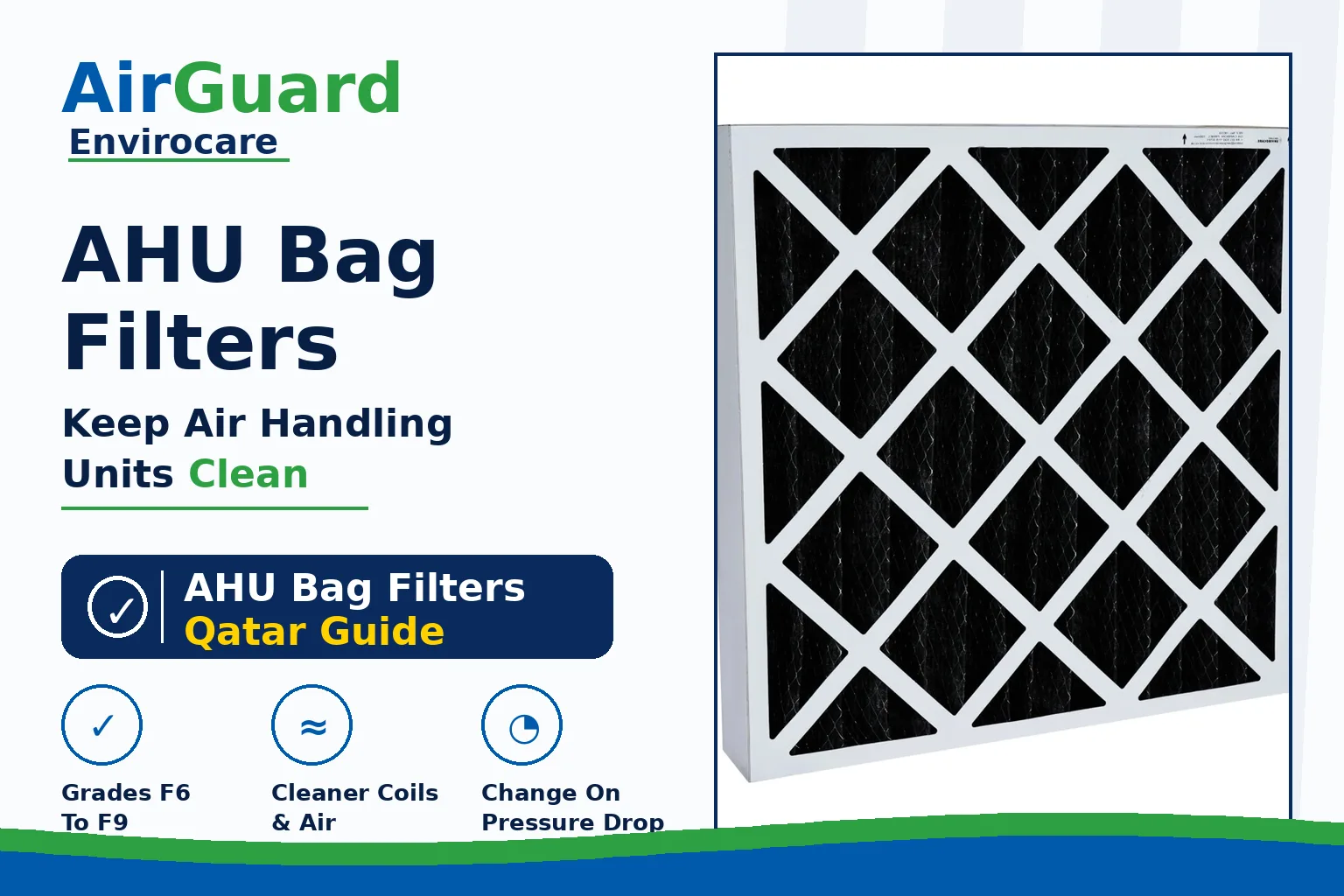
Introduction
The air handling unit is the heart of a building's ventilation system, and the bag filter inside it is the part that decides how clean the air is and how hard the fan must work. An ahu bag filter — a pocket or bag filter fitted in an air handling unit — catches the dust that would otherwise foul the coils, dirty the ductwork and reach the rooms. In Qatar, where heat, dust and humidity all load filters hard, the bag filter in the AHU deserves more attention than it usually gets. This guide explains how AHU bag filters work, which grade to choose, and how to keep an air handling unit clean in Qatari conditions.
What an AHU bag filter does
An air handling unit moves large volumes of air through a building. The air it draws in carries dust from outside, and the air it recirculates carries dust from inside. The bag filter sits in the airstream inside the unit and removes that dust before it reaches the cooling coil, the heating coil and the supply ductwork.
The bag construction is what makes the filter practical for an AHU. Instead of a flat sheet, the media is sewn into deep pockets that hang in the airstream, giving the filter many times the media area of a panel of the same face size. That large area means the filter holds a large amount of dust before its resistance rises, so it lasts months between changeouts instead of weeks. In a large AHU serving an office tower, a hospital or a factory, that long life is what makes the system maintainable at all.
The bag filter also protects the coil. A coil fouled by bypass dust loses heat-transfer efficiency and is expensive to clean, while the filter that would have protected it is cheap by comparison. In that sense the bag filter is the cheapest insurance in the AHU — and the most neglected.
The grades: F6 to F9
AHU bag filters are supplied in the standard grades from F6 to F9, and the grade decides how fine the dust is that the filter captures. F6 is a medium-efficiency grade for general ventilation. F7 is the workhorse grade for commercial and industrial air handling, and the F7 bag filter is the most widely specified AHU bag filter. F8 and F9 step up to finer dust for applications that need cleaner air — hospitals, electronics, food processing and buildings where the air quality standard is tight.
The right grade is the lowest grade that meets the application's needs. A filter finer than the application needs costs more on every changeout, loads faster and raises fan energy for no benefit. A filter coarser than the application needs lets dust through to the coil and the rooms. The requirement should come from the building's design specification or the air quality standard it must meet, not from the catalogue.
Airguard's bag filter range covers all four grades: the F6 bag filter, the F7 bag filter, the F8 bag filter and the F9 bag filter. Each is available as an OEM-equivalent replacement matched to the original filter, so the AHU performs as its designer intended.
The AHU filter train: panel, bag, and what comes after
A well-designed AHU has more than one filter stage. The first stage is a panel pre-filter — typically a G4 panel filter — which catches the coarse dust: the large particles, lint and insects that would otherwise load the bag filter in weeks. The bag filter is the second stage, catching the finer dust that the panel lets through. In some systems a carbon panel filter is added for odour and gas removal.
The pre-filter is the sacrificial stage, changed most often, and it is the cheapest way to extend the life of the bag behind it. A bag filter running without its pre-filter is doing two jobs at once, and its life is cut short. Sites that skip pre-filter changes to save money almost always spend more on bag-filter replacements — and on coil cleaning.
Qatar's conditions: dust, heat and humidity
Qatar loads AHU filters harder than most places, for three reasons. The first is dust: fine desert dust is carried on the wind for much of the year, and it is exactly the size that loads a bag filter steadily. The second is heat: air handling units run hard and long in a climate where cooling is needed for most of the year, so filters accumulate running hours fast. The third is humidity: coastal humidity adds moisture to the media, adds weight to the dust the filter holds, and encourages microbial growth on a loaded filter left in place too long.
These three factors argue for a disciplined approach rather than a calendar one. A filter changed on a fixed date may be changed too early in a quiet month and too late after a dusty spell. The right trigger is the pressure drop across the filter, read from a gauge on the AHU or the building management system, with the calendar as a backstop.
AHU bag filter | Typical service life | Main challenge in Qatar |
|---|---|---|
F6 bag filter | 6 to 12 months | Dust loading from desert winds |
F7 bag filter | 6 to 12 months | Long running hours, heavy dust |
F8 bag filter | 6 to 12 months | Fine dust, humidity on the media |
F9 bag filter | 6 to 12 months | Fine dust, tight air quality needs |
G4 panel pre-filter | 3 to 6 months | Coarse dust, loads fastest |
Carbon panel filter | 3 to 6 months | Odour load and humidity |
When to change an AHU bag filter
The most reliable sign is pressure drop. Every AHU is designed with a final pressure drop — the resistance at which the filter should be changed. When the reading reaches that value, the filter is done, whatever the calendar says. A differential pressure gauge across the filter gives the number directly, and many modern AHUs already have one. A cheap gauge on an older unit pays for itself in the first year.
Visual inspection is the second check. Remove the bag and look at the pockets: heavy, even discolouration is normal loading. Tears, holes, damp patches, a sagging or distorted pocket, or media pulling away from the frame are all reasons to replace immediately, because a damaged bag is not filtering. A bag that is wet needs replacing too — wet media loses strength and efficiency.
Performance changes are the third sign. Falling airflow at the same fan setting, rising fan speed on a variable-speed drive, higher energy consumption, dust visible at the supply grilles, odours, or a room that will not hold temperature all point the same way. In an AHU, the classic symptom is a building that will not cool properly on a hot day — and the cause is often a filter, not the chiller.
Changing an AHU bag filter properly
A good changeout is quick but not careless. Isolate the fan or shut the unit down so the filter is not changed under suction, which can pull dust past the frame. Remove the old bag without shaking it over the clean side of the unit. Inspect the housing: clean the tracks, check the gaskets and seals, and look for corrosion or damage. Fit the new bag the right way round — airflow direction is marked on the frame, and a filter fitted backwards will not seal. Check the seal all round the frame, record the date and the pressure drop reading, and restart the unit.
Record-keeping is the part most sites skip and most regret skipping. A simple log — date, filter type, pressure drop before and after, any damage found — turns replacement from a guess into a system. After a year of records, the right interval for that building is visible in the data, and the dusty-season change can be planned instead of improvised. The guide to air filter replacement explains how to build that schedule in detail.
Common AHU filter mistakes
The most common mistake is running bags too long. The second is changing them too early on a fixed calendar while ignoring pressure drop — which wastes filter life. The third is fitting the wrong filter: a cheaper panel where a bag filter was specified, or a bag of the right size but the wrong grade. The fourth is ignoring the housing: new bags in a leaking housing protect nothing, and a leaking AHU also wastes conditioned air. The fifth is buying on price alone without checking that the replacement is a true equivalent of the original — dimensions, grade and media behaviour all matter, not just the frame size.
The mistakes to watch for, in short:
Running bags past their final pressure drop
Changing on the calendar and ignoring the gauge
Fitting the wrong grade or a poor seal
Ordering after the old filter is already done
In Qatar there is a sixth mistake worth naming: changing filters only when the building complains. By the time rooms will not hold temperature, the filter has been overloaded for weeks, the coil is fouled, and the energy bill has been climbing all along. A pressure-drop schedule catches the problem while it is still a filter change, not a coil clean.
Planning supply and lead time
Filters are made to order with a four-week lead time, so the replacement should be ordered before the existing bag reaches its final pressure drop, not after. Keep a small stock of the filters the building uses most — the grades and sizes that appear in the most AHUs — and order the rest against the changeout schedule. For a site in Qatar, that means ordering ahead of the dusty season and the hottest months, when the AHUs are working hardest and a late changeout costs the most.
If the original part number is known, Airguard's specification matching service identifies the correct OEM-equivalent from it, so the replacement matches the original on dimensions, class and media behaviour. For a firm price on the exact filters the building needs, request a free estimate — the estimate is free, and the filters carry a 12-month manufacturing warranty.
Wrapping up
An AHU bag filter is a simple component with an outsized effect on a building: it decides how clean the air is, how hard the fan works, and how long the coil lasts. In Qatar's dust, heat and humidity, the bag filter works harder than in most places, and it repays a disciplined approach — the right grade, a working pre-filter, a changeout schedule built on pressure drop, and orders placed ahead of the four-week lead time. Done that way, the AHU stays clean, the building stays cool, and the filter remains what it should be: the cheapest maintenance in the building.
Frequently asked questions
What is an AHU bag filter?
A pocket or bag filter fitted in an air handling unit. Its deep pockets give it a large media area, so it holds far more dust than a flat panel and lasts months between changeouts, protecting the coils, the ductwork and the rooms the AHU serves.
Which grade of AHU bag filter should I use?
F6 suits general ventilation, F7 is the workhorse grade for commercial and industrial air handling, and F8 and F9 suit applications needing cleaner air, such as hospitals and clean processes. The right grade is the lowest one that meets the building's design specification.
How often should AHU bag filters be changed in Qatar?
Typically 6 to 12 months, but dust, heat and long running hours in Qatar shorten the life. The proper trigger is the final pressure drop, not the calendar — when the reading reaches the final pressure drop, the filter is done.
What happens if an AHU bag filter is not changed on time?
Pressure drop rises, fan energy climbs, airflow falls, the coil fouls with bypass dust, and rooms will not hold temperature. A late changeout costs far more in energy and coil cleaning than the filter itself.
Do I need a pre-filter in front of an AHU bag filter?
Yes. A G4 panel pre-filter catches the coarse dust that would otherwise load the bag in weeks, and changing it on time can greatly extend the bag filter's life. A bag running without its pre-filter is doing two jobs at once.