
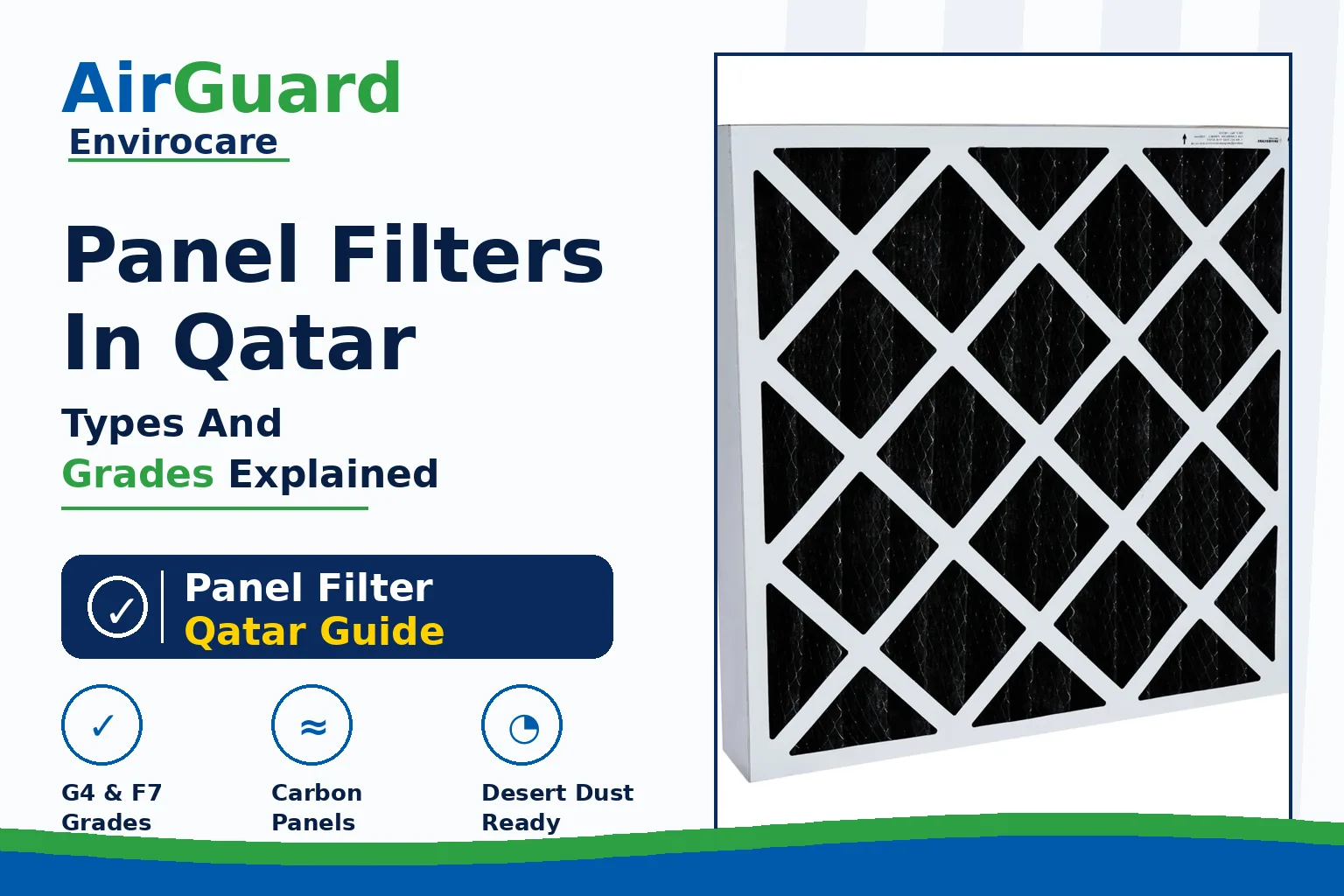
A panel filter is the simplest form of air filtration, and in Qatar it is also one of the hardest-working. A flat sheet of media in a rigid frame, it is the first filter the air meets in most systems, and the one that catches the coarse dust, sand and fibres that would otherwise load the expensive filters behind it. In Qatar's climate — intense heat, fine desert dust, high humidity on the coast, and the dust storms that load filters in hours rather than weeks — the panel filter's job is more demanding than it looks. This guide explains the panel filter types used in Qatar, the grades available, where each type belongs, and how to choose, fit and replace panels for Qatari industrial and commercial sites.
What a panel filter is
A panel filter is a flat filter: a sheet or pad of filter media held in a frame, usually metal or rigid board, that fits into a housing or a filter track. Air passes straight through the media, dust collects on its surface and within its depth, and the clean air passes on. Because the media area is limited to the face area of the frame, a panel filter holds less dust than a pocket or bag filter of the same face size, and it reaches its final pressure drop sooner. That is not a weakness: it is the panel's role. It is the cheap, easily changed first stage that protects the expensive final filter behind it.
Panel filters are used as pre-filters in air handling units, as first stages in gas turbine intake houses, as filters in industrial ventilation and spray booths, and as the only filter in simple ventilation systems where the dust load is light and the air quality requirement is modest. Their simplicity is their strength: they are quick to inspect, quick to change, and easy to stock.
G4 panel filters: the coarse pre-filter
The G4 panel filter is the standard coarse pre-filter. It catches large dust, sand, fibres, insects and the coarse fraction of desert dust, and it does so at a low pressure drop. In Qatar, where airborne dust is fine and persistent, the G4 panel is the filter that takes the first and heaviest load, and it is the filter that should be changed most often.
A G4 panel changed on time protects everything behind it. A G4 panel left in place too long loads up, its pressure drop climbs, and the dust it should have caught passes through to the final filter, which then loads quickly and needs changing early. The economics are clear: the G4 panel is the cheapest filter in the system, and changing it on time is the cheapest maintenance in the building. Sites that skip panel changes to save money almost always pay more in final-filter replacements.
F7 panel filters: finer capture in a flat form
The F7 panel filter is a finer panel, used where the duty needs more capture than a G4 can give, or where the housing has room for a panel but not for a deep pocket. F7 panels are used as final filters in some commercial HVAC systems, as intermediate stages in industrial ventilation, and as pre-filters ahead of high-efficiency final filters where a finer pre-filter is needed.
In Qatar, F7 panels suit air handling units in offices, hospitals, hotels and commercial buildings where indoor air quality matters and the dust load is moderate. They also suit industrial ventilation where the process dust is fine and a G4 alone would let too much through. The choice between G4 and F7 is a choice about the air quality the system must deliver and the dust load it must handle, and it should be made on the application's requirement, not on the price of the panel alone.
Carbon panel filters: particles plus odour
The carbon panel filter adds odour and gas removal to particle capture. Its media is loaded with activated carbon, which adsorbs odours and some gaseous contaminants as the air passes through. Carbon panels are used where odour is a problem — in kitchens and food processing, in commercial buildings near traffic or industrial sources, in process areas where odours must be controlled, and in any system where the air must be acceptable to occupants as well as clean.
Carbon panels have a different service life from plain panels. Their particle-capture life is set by dust loading, as with any panel, but their odour-removal life is set by the carbon becoming saturated. A carbon panel that is still catching dust may have stopped removing odour, and it should be changed when either function is exhausted. In Qatar's hot climate, odour loads can be high, and carbon panels should be inspected for odour breakthrough as well as for pressure drop.
Industrial panel filters: built for the plant
Industrial panel filters are panel filters built for industrial duties: heavier frames, tougher media, and construction that tolerates the vibration, temperature and dust loads of plant environments. They are used as pre-filters in turbine intake houses, as filters in industrial ventilation and process air, and as the first stage in systems where the panel must survive conditions a light commercial panel would not.
In a gas turbine intake, the industrial panel is the first stage of a train that continues through coalescer and high-efficiency stages. Its job is to catch the coarse dust and sand before they reach the coalescer, so the coalescer can do its liquid-removal job without being loaded with solids. Gas turbine intake filters in Qatar face heat, dust and coastal humidity together, and the panel stage is what keeps the rest of the train working. The coalescer panel filters behind the panel stage remove the moisture and salt spray that the panel cannot, and the high-efficiency final filter finishes the job.
Grades and what they mean
Panel filters are graded by how finely they capture particles. G4 is a coarse grade, used for pre-filtration. F7 is a fine grade, used where cleaner air is needed. The table below summarises the main panel types, their grades and their typical duties in Qatar.
Panel type | Grade | Typical duty in Qatar |
|---|---|---|
G4 panel filter | G4 coarse | Pre-filter in HVAC and turbine intakes |
F7 panel filter | F7 fine | Final or intermediate filter in commercial HVAC |
Carbon panel filter | Particle plus odour | Odour control in commercial and food areas |
Industrial panel filter | G4 to F7 range | Pre-filter in industrial and turbine duties |
Glass panel filter | G3 coarse | Light pre-filter, simple ventilation |
Pre-pocket panel | Pre-filter panel | First stage ahead of pocket and bag filters |
The grade should be matched to the duty. A finer panel than the application needs will load faster, raise pressure drop sooner, and need changing more often, without improving the outcome. A coarser panel than the application needs will let dust through to the filters and equipment behind it. The right grade is the one the system was designed around, and the original specification or the original part number is the best guide to it.
Qatar's conditions: desert dust, heat and coastal humidity
Qatar's dust is fine, persistent and abrasive. Desert dust storms can load a panel filter in hours, and the dry season keeps airborne dust high for months. A panel filter in Qatar will load far faster than the same panel in a temperate climate, and the changeout interval should be set from pressure-drop readings at the site, not from a generic schedule. Sites that change panels on a fixed calendar, without reading pressure drop, will either change too early and waste filter life, or too late and pay in fan energy and downstream loading.
Heat is the second factor. High ambient temperatures raise the temperature of plant rooms and intake air, and the panel media and frame must tolerate the operating temperature. Humidity is the third: coastal sites face humid air and salt spray, which add moisture and salt to the dust load, corrode frames and housings, and test the seals. A panel filter in a coastal Qatari site needs a frame and a housing seal that will survive salt air, and an inspection routine that checks for corrosion as well as for dust loading.
Sizing, fitting and sealing
Sizing a panel filter starts with the face dimensions of the housing and the airflow rate. The panel must fit the housing exactly: a panel that is a few millimetres out will leave a gap, and air will bypass the media through the gap. That bypass defeats the filter entirely, because the air that passes around the panel is unfiltered air. The frame must also be rigid enough to stay flat when the media loads and the pressure drop rises, because a panel that bows or distorts will open gaps at its edges.
Fit the panel the right way round, with the airflow direction as marked on the frame. Check the seal all round the frame after fitting, and check the housing tracks and gaskets for damage or corrosion. Record the installation date and the clean pressure drop, so later readings can be compared with a known starting point. These are small steps, and they are the difference between a filter that protects the system and a filter that only looks as if it does.
Replacement: when and how
Change a panel filter when its pressure drop reaches the final limit for the system, or when inspection finds tears, damp patches, a distorted frame or media pulling away from the frame. In Qatar's dust, the interval will be shorter than in milder climates, and during dust storms it may be much shorter. Inspect panels after a dust storm, not just on the routine schedule, because a storm can load a panel in a single day.
A good changeout is quick but not careless. Follow these steps each time:
Isolate the fan or shut the unit down so the panel is not changed under suction
Remove the old panel without shaking it over the clean side
Inspect the housing, clean the tracks, and check the gaskets and seals for corrosion
Fit the new panel the right way round and check the seal all round the frame
Record the date and the pressure drop, then restart the system
Keep a stock of the panel types the site uses most: panel filters are commonly made to order, and a four-week lead time is standard for made-to-order industrial filters, so a changeout delayed for want of a panel is a changeout that should have been planned.
Wrapping up
Panel filters are simple, cheap and easily overlooked, and that is exactly why they deserve attention. In Qatar, the panel is the filter that takes the first and heaviest load of desert dust, and the filter whose timely change protects the coalescer and the high-efficiency final filter behind it. Choose the grade the duty needs — G4 for coarse pre-filtration, F7 where finer capture is required, carbon where odour must be removed — fit the panel so it seals, and change it on pressure drop, with extra inspections after dust storms. Done that way, the cheapest filter in the system does the most valuable job in it. For a site-specific recommendation, use specification matching to check the replacement against the original, and request a free estimate with the panel type, dimensions and quantity.
Frequently asked questions
What is a panel filter used for in Qatar?
Panel filters are the first stage in most Qatari air systems, catching coarse desert dust, sand and fibres before they reach the coalescer and high-efficiency filters behind them. They are also used as final filters in commercial HVAC where the duty suits a flat filter.
What is the difference between a G4 and an F7 panel filter?
G4 is a coarse pre-filter grade that catches large dust at low pressure drop. F7 is a finer grade that captures smaller particles, used where cleaner air is needed or where the housing suits a panel rather than a deep pocket.
How often should panel filters be replaced in Qatar?
There is no single interval, because dust storms can load a panel in hours. Change on the final pressure drop for the system, and inspect after dust storms as well as on the routine schedule.
What does a carbon panel filter do that a plain panel does not?
It removes odour and some gaseous contaminants as well as particles, using activated carbon in the media. It should be changed when either its dust capacity or its odour-removal capacity is exhausted.
Why does my new panel filter not seal properly?
Usually because the panel dimensions do not match the housing exactly, or because the housing tracks or gaskets are damaged or corroded. A panel a few millimetres out will leave a bypass gap, and air passing around the panel is unfiltered.
References
G4 panel filter — https://airguardenvirocare.com/products/g4-panel-filter
F7 panel filter — https://airguardenvirocare.com/products/f7-panel-filter
carbon panel filter — https://airguardenvirocare.com/products/carbon-panel-filter
industrial panel filters — https://airguardenvirocare.com/category/industrial-panel-filters
coalescer panel filters — https://airguardenvirocare.com/category/coalescer-panel-filters
gas turbine intake filters in Qatar — https://airguardenvirocare.com/qa
specification matching — https://airguardenvirocare.com/services/specification-matching
request a free estimate — https://airguardenvirocare.com/request-pricing