
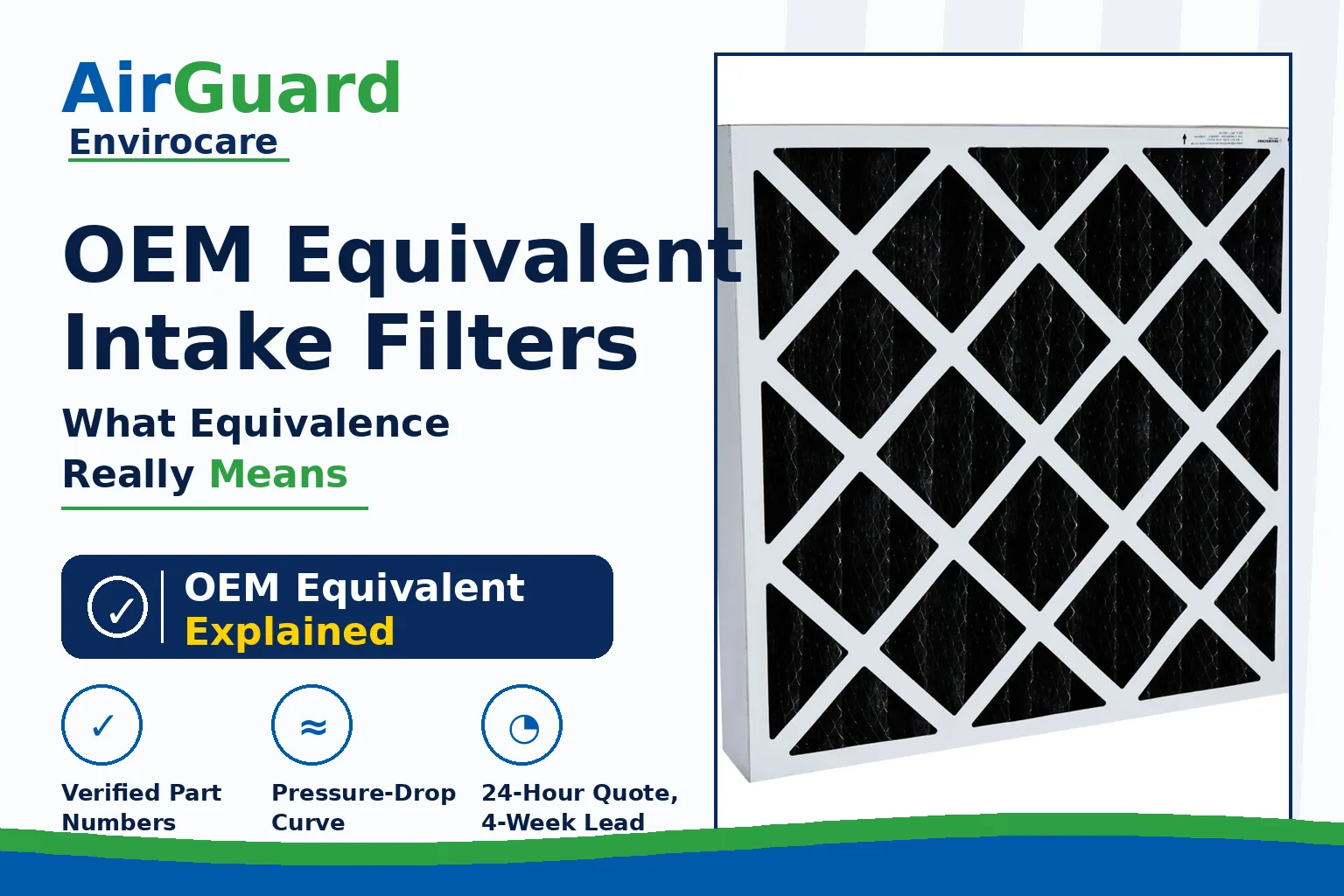
When a gas turbine intake filter needs replacing, the plant has three choices: buy the original manufacturer's filter, buy an equivalent, or buy a generic replacement and hope. The second option — an OEM equivalent gas turbine intake filter — is where most experienced procurement teams land, because it offers the original's performance without the original's lead time and single-source pricing. But the word "equivalent" does a lot of work in that sentence, and not every filter that claims it deserves it. This guide explains what OEM equivalence actually means, how to verify it, and how to specify a replacement that protects the turbine instead of just fitting the frame.
OEM, OEM-equivalent and aftermarket: what the words mean
The terminology used during procurement creates confusion, so it is worth fixing the definitions before anything else.
An OEM filter is supplied by the original equipment manufacturer, or under the original manufacturer's product system. It is the filter the intake was designed around, and it carries the original part number.
An OEM-equivalent filter is manufactured as an alternative to the original component and is intended to meet the relevant dimensional, functional and performance requirements. It is engineered against the original specification — dimensions, efficiency class, media behaviour, pressure-drop characteristic — and cross-referenced to the original part number it replaces.
An aftermarket filter is a broader term covering replacement products from manufacturers other than the original supplier. Not every aftermarket filter is necessarily an engineered equivalent. Some are; some are simply the same size.
The important question is therefore not "Is it OEM?" It is: "Does the replacement satisfy the technical requirements of the installed intake system?" That question should drive the specification — and it is the question this guide helps you answer.
Why part-number matching alone is not enough
Part numbers are valuable starting points, but they do not provide the complete engineering specification. A replacement filter can share a nominal size with the original and still have a different media construction, efficiency, pressure-drop characteristic, filter area, pocket configuration, frame material, gasket position, sealing method, moisture resistance or dust-loading behaviour.
This is particularly important where a filter is part of a multi-stage gas turbine intake system. The intake is a train — pre-filter, coalescer, high-efficiency final — and each stage's performance depends on the stages in front of it. A final-stage filter matched on size alone, behind a coalescer that was matched on size alone, is two guesses stacked on top of each other. The result is usually a filter that fits, loads too fast, and lets fine contamination through to the compressor.
The correct approach is to use the existing part number to identify the starting configuration, then verify the complete replacement specification. Airguard's OEM Part Number Guide cross-references its products to the original part numbers they replace — 153 part numbers across 23 products on the Altair range alone — which gives procurement a verified starting point instead of a guess.
What equivalence must cover
A genuine equivalent must match the original on every characteristic that affects intake performance. The checklist below is the minimum a supplier should be able to answer for any gas turbine intake filters replacement:
Area | What to verify | |
|---|---|---|
Dimensions | Face size, depth, pocket depth, frame, gasket location | |
Performance | Design airflow, face velocity, initial and loaded pressure drop | |
Efficiency | Rated class, test method, and the standard it was tested to | |
Construction | Media type, frame material, support, bonding, gasket and seal | |
Environment | Temperature, humidity, salt and moisture exposure, drainage |
If a supplier cannot answer these — or answers only with dimensions — the filter is not a verified equivalent. It is a filter of the right size.
Efficiency deserves special attention. Filter classes are defined by standards such as ISO 16890 and EN 779, and a class is only meaningful with the test method behind it. The air filters classification guide explains the rating systems and what they mean in practice. A replacement that claims a class without test documentation has not demonstrated equivalence; it has asserted it.
Pressure drop: the parameter that exposes a bad equivalent
Pressure drop is the fastest way to tell a genuine equivalent from a lookalike. Two filters can share dimensions and even an efficiency class, yet have very different resistance at the operating airflow — and resistance is what the turbine feels. A filter with higher resistance than the original raises the intake pressure drop, cuts output and shortens the change-out interval. A filter with lower resistance may be achieving it with less media, which means less dust-holding capacity and a shorter life.
The comparison should therefore include the pressure-loss curve, not a single number. The pressure drop guide explains how to read a pressure-drop curve and what to ask for. For EPC documentation, always establish the design airflow, face velocity, initial pressure drop, maximum allowable pressure drop and the loaded pressure drop at the change-out point. If the supplier cannot provide the curve, the equivalence claim is unverified.
The coalescer stage: where equivalence is hardest to see
The coalescer stage is where poor equivalents do the most damage and are hardest to spot. A coalescer panel does not just filter particles; it captures fine water droplets and salt aerosol, merges them into larger drops and drains them away. That behaviour depends on the media's surface properties, not just its pore size. A replacement coalescer with the right dimensions but the wrong media will pass salt aerosol straight through to the final filter and the compressor — and the plant will only discover it at the next blade inspection.
The coalescer panel filter guide works through a real example: Airguard's CP2-AG, an OEM-equivalent coalescer panel for Altair System 2, Neptune and Vega systems, whose stated technology combines coalescing and mechanical filtration. The lesson generalises: for the coalescer stage, ask how the media handles water, not just what size it is.
How to specify an OEM-equivalent replacement
A good specification contains enough information for a supplier to identify the correct replacement without relying on assumptions. For an EPC or plant team, the specification should include:
Dimensional information: face dimensions, filter depth, pocket depth where applicable, frame dimensions, gasket location, holding-frame interface, installation orientation.
Performance information: design airflow, face velocity, initial pressure drop, maximum allowable pressure drop, filtration efficiency, test method, dust-loading requirements, operating temperature.
Construction information: media type, frame material, support construction, adhesive or bonding arrangement, gasket material, seal configuration, drainage requirements.
Environmental information: coastal or inland, humidity, salt exposure, dust loading, wet or dry operation.
Send that specification — together with the original part number — to the supplier, and ask for the equivalent in writing: original part number, proposed equivalent, and the dimensions, class and media stated together. Airguard's specification matching service works from exactly this information, and the engineering team can assess an existing OEM specification and produce a direct equivalent matched on dimensions, media and performance. Quote requests are answered within 24 hours, and the standard lead time for made-to-order industrial filters is four weeks, so a specification sent early never delays a change-out.
The cost question, answered honestly
The reason most plants switch to equivalents is cost and availability: a single-source OEM filter can carry a long lead time and a price that reflects the monopoly, not the media. An equivalent from a UK manufacturer, built under ISO 9001 and tested to the same standards, removes both problems. But the saving is only real if the equivalent performs. A cheap filter that loads in half the time, or that lets salt through to the compressor, costs far more than the OEM filter it replaced — in washes, in lost output, and in blade life. That is why the verification steps in this guide matter more than the unit price. Buy the equivalent that can prove itself, not the one that is merely the same size.
Parker / Altair equivalent Filters are the most-specified example of this in gas turbine intakes: a large installed base, well-documented original systems, and a mature equivalent range. The same verification discipline applies to every OEM, though — GE, Siemens, Solar or any other turbine manufacturer's intake. The part number is the starting point; the specification is the proof.
Wrapping up
An OEM equivalent gas turbine intake filter is an engineered replacement, not a commodity swap. Match it on dimensions, efficiency class, media behaviour and pressure drop; verify it against the original part number; ask for the pressure-loss curve and the test data; and keep the match on file for the next order. Done that way, equivalence is not a compromise. It is the intake performing exactly as designed, with a supplier that answers in 24 hours and delivers in four weeks. To start a match, send the existing part number and the specification — and request a free estimate for the filters the intake needs.
What is an OEM equivalent gas turbine intake filter?
It is a replacement filter manufactured as an alternative to the original manufacturer's component, engineered to meet the same dimensional, functional and performance requirements — dimensions, efficiency class, media behaviour and pressure-drop characteristic — and cross-referenced to the original part number it replaces.
How do I verify an equivalent filter is genuine?
Ask for the match in writing: original part number, proposed equivalent, dimensions, efficiency class with test method, media construction and the pressure-loss curve. If the supplier can only confirm the size, the equivalence is unverified.
Is an OEM-equivalent filter as good as the original?
It can be, provided it is a true equivalent — same dimensions, same efficiency class, same media behaviour, verified against the original part number. Airguard supplies Altair equivalent Filters and other OEM-equivalent replacements matched to original part numbers under ISO 9001 production, with a 12-month warranty.
Why is pressure drop important when comparing equivalents?
Pressure drop is what the turbine feels. Two filters of the same size can have very different resistance at operating airflow. Higher resistance cuts output; lower resistance can mean less media and a shorter life. Compare the pressure-loss curve, not a single number.
What information do I need to get a quote for an equivalent filter?
The original part number, filter dimensions, airflow, required efficiency class and the operating environment (coastal, dusty, humid, and so on). With those, the supplier can identify the correct equivalent and quote it — Airguard responds to quote requests within 24 hours.