
Introduction
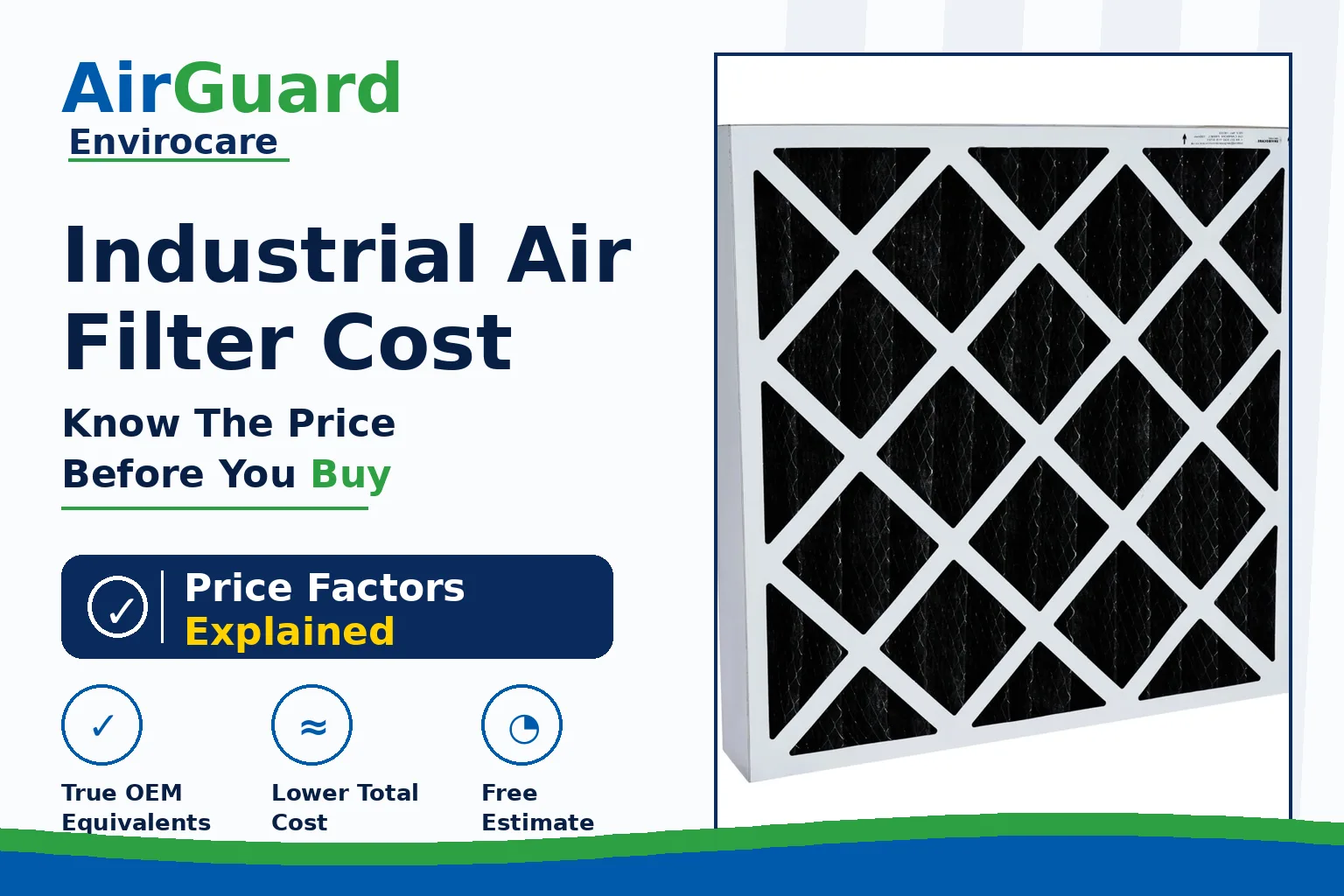
Ask ten suppliers what an industrial air filter costs and you will get ten different answers, because there is no single price for an industrial air filter. Industrial air filter cost depends on the filter type, the efficiency class, the size, the media, the quantity and the service behind it — and the purchase price is only part of what the filter really costs over its life. This guide explains every factor that decides the price, so you can compare quotes properly and avoid the most expensive mistake in filtration: buying the cheapest filter.
The factors that decide the price
Filter type comes first. A simple G4 panel filter and a high-efficiency pocket filter are different products with different materials, different manufacturing steps and different prices. Pocket and bag filters use far more media than a flat panel, and a coalescer panel carries specialised media and drainage construction. Rigid bag and V-cell filters sit higher again, because their construction holds more media in a smaller frame. Comparing prices across types is meaningless — the comparison only works within the same type and class.
Efficiency class is the second factor. Moving from G4 to F7 to F9 means finer media, more of it, and tighter manufacturing control. Each step up costs more to make and more to buy. The right question is not whether the higher class costs more — it does — but whether the application needs it. A turbine intake needs it. A warehouse pre-filter does not. Over-specifying wastes money on every changeout for the life of the system.
Size and quantity follow. Larger filters use more material and cost more per unit, but they also hold more dust and last longer, so the cost per month of service can be lower. Quantity changes the arithmetic too: a plant ordering a year's supply of one filter type will get a better unit price than a site ordering two filters at a time, and it also avoids the emergency orders that always cost more.
Media is the quiet price driver. Synthetic media, glass fibre, PTFE-treated media and carbon-loaded media all carry different costs, and the media decides how the filter behaves: how much dust it holds, how its pressure drop rises, whether it tolerates moisture. A filter that looks identical from the outside can behave very differently because of what is inside it. This is why two quotes for the "same" filter can differ so much — they are often not the same filter at all.
OEM vs OEM-equivalent: where the saving is
Original equipment filters carry the manufacturer's name and its pricing. OEM-equivalent filters are built to the same dimensions, the same efficiency class and the same performance, without the original brand's markup. For most industrial buyers this is the single biggest saving available in filtration — the same protection, the same fit, at a meaningfully lower price.
The saving is real only when the equivalent is a true equivalent. Dimensions, efficiency class, media type and frame construction must all match the original. A filter that is a few millimetres out will not seal, and a filter of the wrong class will not protect. Airguard supplies Altair equivalent filters and other OEM-equivalent replacements matched to the original part numbers, including the CP2 coalescer panel filter. When the match is exact, the saving is pure — same performance, lower price, no compromise.
The price you pay vs the price it costs
The purchase price is the smallest part of a filter's real cost. The largest part is usually energy. As a filter loads, its pressure drop rises and the fan works harder. A filter with a low clean pressure drop and a slow rise costs less to run over its life than a cheaper filter that chokes the system in half the time. In a large air handling system or a turbine intake, the energy difference across a year can dwarf the purchase price several times over.
Changeout cost is the second hidden cost. A filter that needs changing twice as often costs twice the labour, twice the downtime and twice the disposal — even if each filter is cheaper. Dust-holding capacity, which decides how long a filter lasts before it reaches its final pressure drop, is therefore a price factor, not just a technical detail. A filter with higher capacity may cost more per unit and less per month.
Downtime and damage are the third hidden cost, and the most expensive. A filter that fails early, bypasses or lets contaminants through can cause a compressor wash, a coil clean, a production stop or a product quality failure. None of these appear on the filter invoice. They are the real cost of buying the cheapest filter.
The honest way to compare filters is total cost of ownership: purchase price plus energy over the service life, plus changeout labour and downtime, plus the risk of downstream damage. On that measure, the cheapest filter on the quote is very often the most expensive filter in the building.
What changes the price by application
Gas turbine intakes are the most demanding application and the most expensive filters, because the cost of failure is highest. Coalescer stages, high-efficiency final filters and exact OEM-equivalent matching all add cost — and all pay for themselves in protected output. HVAC filters are the most price-sensitive in the other direction: the volumes are large, the classes are standard, and the saving comes from correct specification and bulk ordering rather than from exotic media.
Spray booth filters are consumed fast and bought often, so unit price and supply reliability matter more than service life. Marine and offshore filters carry the cost of moisture and salt resistance. Food and pharmaceutical plants pay for certification and traceability. The application decides which factors matter, and a quote that ignores the application is a quote that cannot be compared.
How to get an accurate price
A useful quote needs the right information. The filter type and efficiency class, the exact dimensions, the quantity, the operating environment and the original part number if it is a replacement. With those five things, a supplier can price accurately. Without them, any price is a guess, and the final invoice will differ from the quote.
It also helps to ask what is included: delivery, lead time, and whether the supplier will match the filter to the original part number. A four-week lead time is standard for made-to-order industrial filters, and planning around it avoids the emergency orders that cost the most. Airguard's specification matching service identifies the correct equivalent from the original part number, so the quote is for the right filter the first time.
For a firm price on your filters, request a free estimate with the filter details — the estimate is free, and it is based on the exact filter your system needs.
How to cut filter costs without cutting corners
There are honest ways to spend less. Match the efficiency class to the application instead of over-specifying. Use pre-filters to protect expensive final filters — a cheap pre-filter changed on time can double the life of the filter behind it. Order in bulk where the site uses one filter type in volume. Standardise on one equivalent supplier instead of buying whatever is available each time. And keep air filter replacement on a pressure-drop schedule, so filters are changed when they are done, not early out of habit or late out of neglect.
What does not save money is buying an unbranded filter of unknown class, fitting the wrong size, or skipping the pre-filter stage. Each of those saves a little on the invoice and costs a lot downstream.
Wrapping up
Industrial air filter cost is decided by type, class, size, media, quantity and the service behind the filter — and the purchase price is only the beginning. The real comparison is total cost of ownership: energy, changeout, downtime and risk. On that measure, a true OEM-equivalent filter, correctly specified and changed on pressure drop, is almost always the cheapest filter a plant can buy. Get the specification right, get a firm quote for the exact filter, and judge the price over the filter's life, not on the day it arrives.
Frequently Asked Questions
1. How much do industrial air filters cost?
There is no single price: cost depends on filter type, efficiency class, size, media and quantity. The purchase price is only part of the total — energy, changeout labour and downtime over the filter's life usually matter more.
2. Are OEM-equivalent filters cheaper than original filters?
Yes, when they are true equivalents: same dimensions, same efficiency class and same media behaviour as the original, without the original brand's markup. The saving is only real if the match is exact.
3. Why do two quotes for the same filter differ so much?
Because they are often not the same filter. Media type, efficiency class, dust-holding capacity and frame construction all change the price, and a quote without the full specification cannot be compared with another.
4. What is the total cost of owning an air filter?
Purchase price plus the energy cost of its pressure drop over its service life, plus changeout labour and downtime, plus the risk of downstream damage if it fails. The cheapest filter on the quote is often the most expensive over its life.
5. How can I get an accurate price for my filters?
Provide the filter type, efficiency class, exact dimensions, quantity, operating environment and the original part number. With those, a supplier can quote the exact filter — request a free estimate from Airguard.