
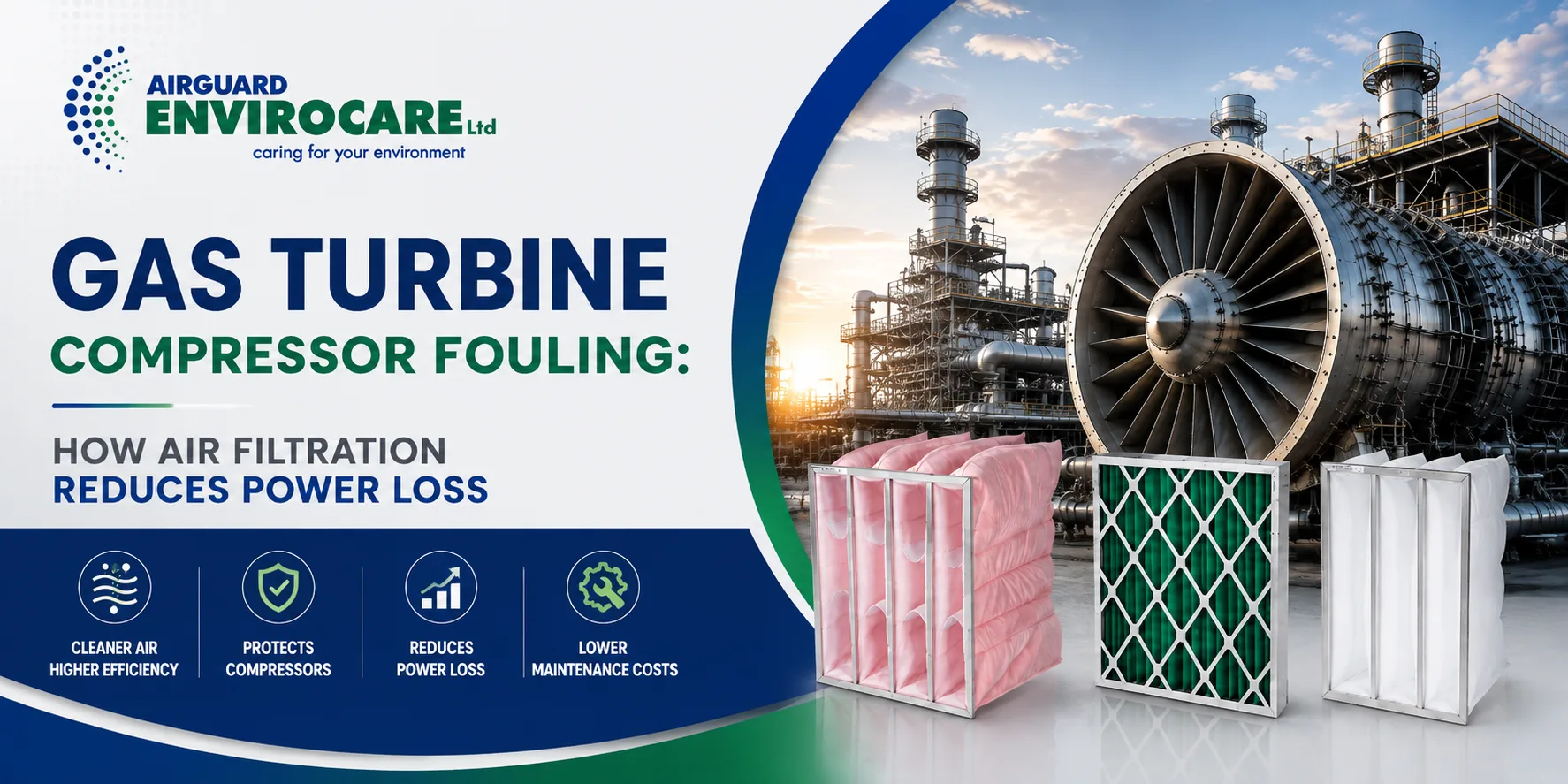
What Is Compressor Fouling, and Why Does It Cost You Power?
Compressor fouling happens when airborne particles stick to the blades and stationary vanes inside a gas turbine's compressor. Over time, this buildup roughens the blade surface and narrows the airflow path. A compressor that was designed to move air smoothly now has to work harder to do the same job.
That extra effort shows up in three places: lower power output, worse heat rate, and higher fuel consumption for the same load. Industry data on axial compressors consistently points to fouling as the single largest cause of gradual turbine performance loss between major overhauls. Unlike a mechanical failure, fouling rarely announces itself. It shows up as a slow, steady decline that many operators mistake for normal wear.
The frustrating part is that fouling is largely preventable. The particles that cause it almost always enter through the air intake system, which means the inlet filtration stage is the first and best place to stop the problem.
How Fouling Actually Happens Inside the Compressor
Fouling is not simply dust settling on a surface. It is a chemical and physical process that depends on two things arriving together: fine particles and something sticky enough to hold them in place.
The Two Ingredients Fouling Needs
Dry dust alone often bounces off compressor blades and passes through the engine. The real damage happens when that dust mixes with oil mist, salt aerosol, moisture, or hydrocarbon vapour already present in the intake air. This mixture forms a tacky film on the blades, and every particle that touches it afterwards adds another layer.
Common Fouling Contributors
Fouling Contributor | Common Source | Effect on Compressor |
Fine dust and sand | Ambient air, desert or arid sites | Builds a rough coating on blade surfaces |
Salt aerosol | Coastal air, sea spray, marine sites | Combines with dust to form a sticky, corrosive film |
Oil mist and hydrocarbon vapour | Nearby industrial processes, engine bay leaks | Acts as the "glue" that traps other particles |
Pollen and organic matter | Seasonal, rural or agricultural areas | Adds bulk to existing fouling deposits |
Moisture and humidity | Coastal, tropical or high-humidity climates | Increases particle adhesion to blade surfaces |
This is why two turbines running the same air volume can foul at very different rates. A dry inland site with clean filtration might see fouling develop over years. A coastal site with weak salt protection can see a measurable power loss within a few months.
The Real Cost of Ignoring Compressor Fouling
Fouling does not cause a sudden failure, which is exactly why it is easy to underestimate. The cost builds quietly across several areas of plant performance.
Symptom | What It Means for the Plant |
Falling power output | The turbine can no longer hit its rated capacity at the same fuel input |
Rising heat rate | More fuel is needed to produce the same amount of power |
More frequent compressor washing | Operators wash more often to claw back lost performance, adding downtime |
Higher vibration and blade stress | Uneven deposits create imbalance, raising long-term maintenance risk |
Shorter intervals between overhauls | Fouling accelerates wear on downstream components |
A few percentage points of lost power output rarely triggers an emergency response. But multiply that loss across every operating hour of the year, and it becomes one of the largest avoidable costs on a turbine's balance sheet. Plants that treat fouling as routine maintenance, rather than a filtration problem, tend to keep paying that cost year after year.
How Proper Air Filtration Prevents Fouling
The most effective way to control fouling is to stop the contaminants before they reach the compressor, not to clean the blades after the fact. That means building the intake filtration system around the specific mix of contaminants the site actually faces.
The Three-Stage Filtration Approach
A well-designed inlet filtration system generally works in stages:
Coarse pre-filtration removes bulk debris, insects and larger dust particles before they reach the finer stages.
Coalescing filtration targets moisture, salt spray and oil aerosol, the "glue" that makes fouling stick in the first place.
Fine or high-efficiency filtration, rated to EN 1822 or ISO 16890 classes, captures the small particulate that would otherwise pass straight through into the compressor.
Skipping or under-specifying any one of these stages leaves a gap. A site with strong particulate filtration but no coalescing stage will still see fouling accelerate whenever humidity or salt spray rises, because the moisture that binds dust to the blades was never removed.
Why Media Type Matters as Much as Efficiency Class
Media type matters just as much as the filter class printed on the datasheet. A hydrophobic, coalescing media designed for marine or coastal duty will outperform a standard particulate filter of the same efficiency rating, simply because it is built to handle the contaminant that causes the most damage.
Where Compressor Fouling Risk Is Highest
Fouling is a turbine-specific problem, but the underlying issue, airborne contaminants degrading equipment performance, shows up across several industries that depend on consistently clean air.
Sector | Why Fouling and Air Quality Risk Is High |
High operating hours and large turbine fleets mean even small efficiency losses compound quickly | |
Remote and often dusty sites combine with process-area hydrocarbon vapour to accelerate fouling | |
Constant salt spray and humidity create ideal conditions for sticky, fast-forming deposits | |
Poor filtration lets particulate foul coils and reduce system efficiency, raising energy costs | |
Data Centers | Airborne particulate can affect cooling efficiency and sensitive electronics over time |
Pharmaceuticals | Contamination control depends on filtration holding to a consistent, verified standard |
Hospitals | Clean air directly affects infection control, not just equipment performance |
For turbine operators specifically, power generation, oil & gas and marine sites carry the highest fouling risk, since they combine long operating hours with some of the harshest intake air conditions in industry.
Choosing the Right Filtration Stage to Stop Fouling Before It Starts
Not every filter type does the same job, and picking the wrong one for a given stage is one of the most common reasons fouling protection underperforms.
Panel filters sit at the front of the system and are built for high airflow with low pressure drop. Their job is to stop bulk debris without forcing the rest of the system to work harder than it needs to.
Coalescer panel filters are the stage most directly responsible for preventing fouling. They pull moisture and salt aerosol out of the airstream before it can combine with dust further downstream. On coastal, offshore or humid sites, this stage matters more than almost any other filtration decision.
Bag Filters and pre-pocket filters handle the intermediate fine-dust load. A filter with more surface area here extends the working life of the final, more expensive stage behind it.
High-efficiency pocket or V-cell filters form the last line of defense, capturing the smallest particulate before it reaches the compressor. This is where the EN 1822 or ISO 16890 rating has the biggest direct impact on fouling risk.
Getting each stage matched to the site's actual contaminant profile, rather than a generic specification, is what separates filtration that genuinely prevents fouling from filtration that just looks adequate on paper.
Washing Won't Undo What Filtration Could Have Prevented
Compressor washing, whether online or offline, is a useful recovery tool, but it is not a substitute for stopping fouling at the source. Washing removes deposits that have already formed; it does nothing to stop new deposits from building up again the next day. Sites that rely heavily on washing schedules are usually treating the symptom while the filtration upstream keeps letting the cause through.
The more effective, and far cheaper, approach is to reduce how much fouling material reaches the compressor in the first place. A properly staged, correctly specified filtration system cuts down on wash frequency, protects power output, and reduces the wear that fouling puts on downstream components.