
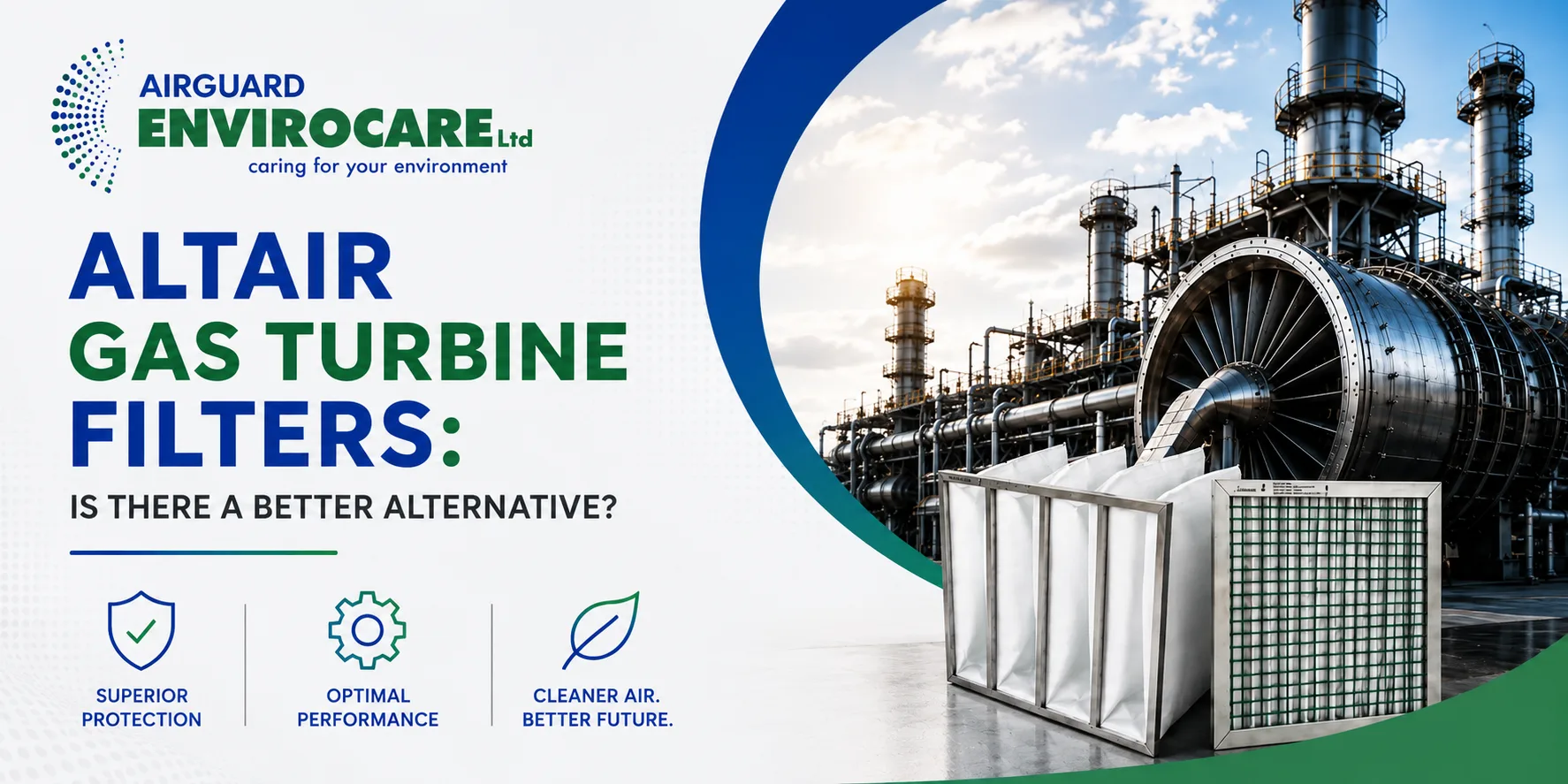
Is Your Gas Turbine Filter Bill Paying for Performance, or Just a Brand Name?
Here's a question worth sitting with before the next purchase order goes out: when you reorder an Altair filter element, are you paying for what it does, or for the name stamped on the frame?
It's a fair question, and not a disloyal one. Altair filtration systems, built by Parker Hannifin, have genuinely earned their reputation across power generation, oil and gas, and marine propulsion. But reputation and pricing don't always move together. Once a filter housing is installed and the OEM part number is locked into your maintenance schedule, every reorder tends to default to the same supplier, at the same premium, without anyone re-checking whether an OEM-equivalent alternative could deliver the same protection for less. That's exactly the gap Airguard Envirocare has built to close its filter range.
That's not a case for cutting corners on filtration. It's a case of reading the datasheet as carefully as the invoice.
What's Actually Inside an Altair Filtration System
Before comparing alternatives, it helps to understand what the Altair range is actually built to do. Parker's Altair portfolio spans several system families, each engineered for a specific operating environment:
Altair System 2: Designed for offshore and coastal turbines, optimised to run at high air velocities with a compact, small-face-area filter house.
Altair Neptune: A three-stage vane/coalescer/vane marine system built for compact installations on ships.
Altair Vega: A three-stage marine propulsion system with a track record spanning decades of protecting ship gas turbines against sea spray and green seas.
Altair Aquila: Used across panel, bag and pre-pocket configurations depending on the vessel or plant's contamination profile.
Each of these systems relies on interchangeable filter elements, panel filters, bag filters, and pre-pocket filters, sized to fit the housing. That modularity is exactly what makes cross-reference alternatives possible: the housing and the airflow engineering stay the same, but the filter element inside it doesn't have to come from a single source to perform to spec.
What Makes a Genuine OEM-Equivalent Alternative
Not every "compatible" filter on the market is actually equivalent. A real cross reference has to match the original on more than just the outside dimensions.
Comparison Point | What to Verify |
Efficiency class | Same EN 1822 (E10-E12, H13-H14) or ISO 16890 rating as the original part |
Media type | Hydrophobic or coalescing properties matched for marine/offshore duty |
Dimensions & face area | Exact fit to the Altair System 2, Neptune, Vega or Aquila housing |
Pressure drop curve | Comparable airflow resistance across the filter's service life |
Certification | ISO 9001 manufacturing and test data available on request |
Filters that tick the dimension box but skip the media and efficiency checks are the ones that quietly under-perform, running a slightly lower efficiency class, or lacking the hydrophobic treatment that protects a marine turbine from salt ingress. That gap rarely shows up on day one. It shows up months later, as a small rise in compressor fouling that's hard to trace back to a filter swap nobody flagged as a performance change.
Where Alternatives Make the Most Sense
Power Generation: Onshore and desert plants running high filter-change volumes are often the biggest beneficiaries of OEM-equivalent parts, simply on volume savings across a large fleet of housings.
Oil & Gas: Remote sites where OEM lead times stretch for weeks benefit from suppliers who can manufacture and ship cross-reference filters faster, without the wait tied to a single-source part number.
Marine, Offshore, Coastal and Marine Propulsion: This is where the equivalence check matters most. Commercial ship and warship gas turbine filters have to hold up against sustained salt spray, so any alternative to an Altair Neptune or Vega element needs matching coalescing and hydrophobic performance, not just a similar-looking panel.
Industry | Why an Alternative Is Worth Evaluating |
Power Generation | High filter-change volume, cost savings compound across a fleet |
Oil & Gas | Remote sites need shorter lead times and reliable stock availability |
Marine (offshore/coastal/propulsion) | Needs matched salt and moisture protection, not just a housing fit |
Matching the Right Altair-Compatible Filter Type to Your System
An Altair housing can run several different filter types depending on the stage it's protecting and the environment it sits in. Before evaluating any alternative on price, it's worth confirming which filter type your system actually needs, since a mismatch at this stage undermines every other comparison further down the line.
Panel Filters
Panel filters sit as the entry point of most Altair System 2 and Aquila configurations, catching bulk particulate and coarse debris before air reaches the finer stages. They're built for high face velocity and low pressure drop, which keeps the rest of the system running efficiently rather than working overtime to compensate for a weak first stage.
Bag Filters
Bag filters handle the intermediate stage, typically rated F7-F9, and are where most of the fine dust load gets captured before it reaches the final EPA element. Dust-holding capacity matters more here than raw efficiency, since a bag filter with more surface area extends the service life of the expensive downstream stage.
Pre-Pocket Filters
Pre-pocket filters do similar work to bag filters but in a more compact rigid-pocket format, which suits Altair System 2, Neptune and Vega housings where space inside the filter house is limited. They're a common choice on offshore platforms and ships, where every inch of footprint counts.
Coalescer Panel Filters
Coalescer panel filters are the answer to moisture and salt, not dust. They pull fine water droplets and aerosol out of the airstream before it reaches the particulate stages, which is why they're standard on marine propulsion and coastal installations rather than dry onshore sites.
V-Cell / Mini-Pleat Filters
V-cell and mini-pleat filters pack more media area into a shallow frame, giving high efficiency without the pressure drop penalty a flat panel would carry at the same rating. They're typically specified as the final EPA stage where space is tight, but the efficiency target is still E11 or E12.
Getting the filter type right at each stage is what makes a cross-reference alternative genuinely equivalent, rather than just a similar-looking substitute. Once the type, stage and efficiency class all line up, the savings conversation becomes straightforward.
The Real Savings Behind an OEM-Equivalent Filter
The cost gap between an OEM part number and a verified equivalent usually isn't about cheaper materials. It comes from the pricing structure itself: Parker Hannifin part number cross-reference filters from independent manufacturers compete on price because they aren't carrying the overhead of a single-brand distribution chain. Airguard Envirocare, for example, manufactures OEM-equivalent coalescer panel, bag and pre-pocket filters built to fit Altair System 2, Neptune, Vega and Aquila housings directly, under ISO 9001 certified production, without the OEM markup.
That's the difference worth chasing: OEM filters cost alternative savings that come from sourcing and manufacturing efficiency, not from a lower filtration standard. If a supplier can't show test data or a documented cross-reference against your existing part number, that's the point to walk away, not the point to save money.
Making the Switch Without the Risk
Switching filter suppliers doesn't have to mean switching blind. A responsible transition looks like this: request the cross-reference documentation against your current Altair part number, confirm the efficiency class and media type match, and trial the alternative on one housing before rolling it out fleet-wide. That single step catches any mismatch before it becomes a maintenance problem across every unit on site.
The Altair name carries real engineering behind it, and that's not in question. What is worth questioning is whether every reorder has to come from the same single source at the same price, when a properly verified alternative can protect the turbine just as well.
Conclusion
Altair filters from Parker Hannifin set a real benchmark for gas turbine inlet protection, but that benchmark can be matched by a properly verified OEM-equivalent alternative, at a lower cost and often a faster lead time. The move isn't about switching for the sake of savings; it's about confirming the efficiency class, media, and dimensions line up before you commit a fleet to a new part number. Get that cross-reference right, and the alternative isn't a compromise; it's simply a smarter way to buy the same protection. Airguard Envirocare manufactures that cross-reference to spec, backed by ISO 9001-certified production and a team that will map it against your existing Parker part number line by line.
Ready to see what you're really paying for? Get your free filter cross-reference and quote from Airguard Envirocare today.